Friday, December 29, 2023

The Sixth Day in the Octave of Christmas

“Presentation of Jesus at the Temple”
by Palma Giovane c. 1600

Readings for the Sixth Day in the Octave of Christmas [1]
 
Reading from the Jerusalem Bible [2]
 
Readings and Commentary: [3]
 
Reading 1: 1 John 2:12-17
 
I am writing to you, children,
because your sins have been forgiven for his name’s sake.
 
I am writing to you, fathers,
because you know him who is from the beginning.
 
I am writing to you, young men,
because you have conquered the Evil One.
 
I write to you, children,
because you know the Father.
 
I write to you, fathers,
because you know him who is from the beginning.
 
I write to you, young men,
because you are strong and the word of God remains in you,
and you have conquered the Evil One.
 
Do not love the world or the things of the world.
If anyone loves the world, the love of the Father is not in him.
For all that is in the world,
sensual lust, enticement for the eyes, and a pretentious life,
is not from the Father but is from the world.
Yet the world and its enticement are passing away.
But whoever does the will of God remains forever.
-------------------------------------------
Commentary on 1 Jn 2:12-17
 
St. John addresses his audience individually on sin and forgiveness using an interesting metaphor for the Trinity: children, fathers, young men. The believing community he addresses is armed through faith against the evil one. He focuses in his last paragraph on avoiding the secular world. He exhorts them to separate themselves from “things” of the world, saying that they are of the world and therefore unworthy of special care; they lead the faithful away from God (see also John 17:9-26 and John 15:18-27).
 
CCC: 1 Jn 2:16 377, 2514, 2534
-------------------------------------------
Responsorial Psalm: Psalm 96:7-8a, 8b-9, 10
 
R. (11a) Let the heavens be glad and the earth rejoice!
 
Give to the LORD, you families of nations,
give to the LORD glory and praise;
give to the LORD the glory due his name!
R. Let the heavens be glad and the earth rejoice!
 
Bring gifts, and enter his courts;
worship the LORD in holy attire.
Tremble before him, all the earth.
R. Let the heavens be glad and the earth rejoice!
 
Say among the nations: The LORD is king.
He has made the world firm, not to be moved;
he governs the peoples with equity.
R. Let the heavens be glad and the earth rejoice!
-------------------------------------------
Commentary on Ps 96:7-8a, 8b-9, 10
 
While Psalm 96 is a song of praise, the psalmist reminds us that even in praise we need to offer what we have in gratitude. The structure is familiar: first we are given the audience ("you families of nations"), then the response ("bring gifts, and enter his courts"), and finally praise of God as a response ("he governs the peoples with equity").
 
-------------------------------------------
Gospel: Luke 2:36-40
 
There was a prophetess, Anna,
the daughter of Phanuel, of the tribe of Asher.
She was advanced in years,
having lived seven years with her husband after her marriage,
and then as a widow until she was eighty-four.
She never left the temple,
but worshiped night and day with fasting and prayer.
And coming forward at that very time,
she gave thanks to God and spoke about the child
to all who were awaiting the redemption of Jerusalem.
 
When they had fulfilled all the prescriptions
of the law of the Lord,
they returned to Galilee,
to their own town of Nazareth.
The child grew and became strong, filled with wisdom;
and the favor of God was upon him.
-------------------------------------------
Commentary on Lk 2:36-40
 
Continuing the story surrounding the presentation of Jesus, in this passage St. Luke describes the prophetess Anna. This role, for widows to prophesy in the temple, was not uncommon. The symbolism depicting Anna has clear linkage back to Old Testament events. It begins with the number seven. Rabbinical literature recognizes seven as the number of prophetesses: Sarah and Miriam in Exodus 15:20, Deborah in  Judges 4:4, Hannah mother of Samuel in 1 Samuel 2:1, Abigail wife of David in 1 Samuel 25:32, Huldah in 2 Kings 22:14, and Esther. These women gave witness to God’s will, at least in their holiness, and spoke in his name. Anna, in this prophetic role (Phanuel translates as “face of God” and Asher as “good luck”), echoes the words of Simeon saying that this young baby (Jesus) is the redemption of Jerusalem. The city, in this instance, represents all of the elect.
 
The final verses provide a glimpse of Jesus’ necessary hidden life in Nazareth. He grows in faith and stature in preparation for the mission assigned to him (we note the favor of God was also assigned to the Blessed Virgin Mary, Luke 1:30). Luke’s description of St. John (Luke 1:80) the Baptist parallels this short synopsis of Jesus’ early life.  [4]
 
CCC: Lk 2:38 711
-------------------------------------------
Reflection:
 
The timing of the first reading from 1 John is very good.  It is almost a week since the great secular glut of commercial Christmas and its aftermath, the post-Christmas feeding frenzy.  Just as we see the children tiring of their new toys and games and the adults thinking about returning to the routines of the world, the evangelist addresses himself to us.  He reminds us first about the meaning of the Nativity whose octave we are still in: “your sins have been forgiven for his name’s sake.”  He then goes on to restate the great Christian paradox found in his own Gospel, to be part of the world but separate from it. 
 
The evangelist warns us about what we just went through: “sensual lust, enticement for the eyes, and a pretentious life,” all part of the commercial Christmas.  It is so pervasive that in the U.S., even religious people of non-Christian denominations gather and buy gifts with no attachment whatsoever to the birth of the Savior.
 
These are not the things of God but, as St. John says, things of the world.  The Christian must be in the world but stand apart from it.  What is truly important is not how well we did “under the tree,” but how well we did by the standards of him who loves us. The Lord came as not just a symbol of love, but love itself, into the world.  St. Luke gives us extra evidence using the prophetess Anna, demonstrating that God’s plan for our redemption requires our constant vigilance.  Even as we think about taking extra good care of the new golf clubs or the new appliance, we should ask ourselves what we are doing to take care of what is really important in ourselves.
 
Today we are reminded of our Christian duty and the role we are called to play in God’s plan.  He casts us into the world like seeds so that we might transform it (not be transformed by it).  Today our voices join with the prophetess Anna in thanking God for the gift of the Christ Child and pledging to rededicate ourselves to the cause which brought him into the world.
 
Pax
 

[1] The picture is “Presentation of Jesus at the Temple” by Palma Giovane c. 1600.
[2] S.S. Commemoratio
[3] The readings are taken from the New American Bible, with the exception of the psalm and its response which were developed by the International Committee for English in Liturgy (ICEL). This republication is not authorized by USCCB and is for private use only.
[4] The Gospel of Luke by Pablo T. Gadenz © 2018, Baker Academic, Grand Rapids MI, p. 72.

Thursday, December 28, 2023

The Fifth Day in the Octave of Christmas

“The Presentation of Christ in the Temple”
by Francesco Bassano, c. 1570’s

Readings for the Fifth Day in the Octave of Christmas [1]
 
Readings from the Jerusalem Bible [2]
 
Readings and Commentary: [3]
 
Reading 1: 1 John 2:3-11
 
Beloved:
The way we may be sure that we know Jesus
is to keep his commandments.
Whoever says, “I know him,” but does not keep his commandments
is a liar, and the truth is not in him.
But whoever keeps his word,
the love of God is truly perfected in him.
This is the way we may know that we are in union with him:
whoever claims to abide in him ought to walk just as he walked.
 
Beloved, I am writing no new commandment to you
but an old commandment that you had from the beginning.
The old commandment is the word that you have heard.
And yet I do write a new commandment to you,
which holds true in him and among you,
for the darkness is passing away,
and the true light is already shining.
Whoever says he is in the light,
yet hates his brother, is still in the darkness.
Whoever loves his brother remains in the light,
and there is nothing in him to cause a fall.
Whoever hates his brother is in darkness;
he walks in darkness
and does not know where he is going
because the darkness has blinded his eyes.
-------------------------------------------
Commentary on 1 Jn 2:3-11
 
This selection provides two consistent teachings of St. John. First is the injunction to keep Jesus' commandments. He uses the same formula we have heard before in this letter. If you say you belong to Christ but do not follow his commandments, you are a liar.
 
The second teaching is his favorite, perhaps because it is part of the great commandment and fundamental to everything taught by the Lord: “Love one another.” Here St. John again uses the darkness and light theme to demonstrate that the one who walks with Christ is in the light and the one who does not walks in darkness and is lost: “he walks in darkness and does not know where he is going because the darkness has blinded his eyes.”
 
-------------------------------------------
Responsorial Psalm: Psalm 96:1-2a, 2b-3, 5b-6
 
R. (11a) Let the heavens be glad and the earth rejoice!
 
Sing to the LORD a new song;
sing to the LORD, all you lands.
Sing to the LORD; bless his name.
R. Let the heavens be glad and the earth rejoice!
 
Announce his salvation, day after day.
Tell his glory among the nations;
among all peoples, his wondrous deeds.
R. Let the heavens be glad and the earth rejoice!
 
The LORD made the heavens.
Splendor and majesty go before him;
praise and grandeur are in his sanctuary.
R. Let the heavens be glad and the earth rejoice!
-------------------------------------------
Commentary on Ps 96:1-2a, 2b-3, 5b-6
 
Psalm 96 is a song of praise acknowledging God as King of all the earth. It has roots in 1 Chronicles 16:8-36 as part of a chant of thanksgiving during the transfer of the Ark of the Covenant to the temple in Jerusalem, but most importantly it celebrates God’s omnipotence and enduring salvation.
 
CCC: Ps 96:2 2143
-------------------------------------------
Gospel: Luke 2:22-35
 
When the days were completed for their purification
according to the law of Moses,
the parents of Jesus took him up to Jerusalem
to present him to the Lord,
just as it is written in the law of the Lord,
Every male that opens the womb shall be consecrated to the Lord,
and to offer the sacrifice of
a pair of turtledoves or two young pigeons,
in accordance with the dictate in the law of the Lord.
 
Now there was a man in Jerusalem whose name was Simeon.
This man was righteous and devout,
awaiting the consolation of Israel,
and the Holy Spirit was upon him.
It had been revealed to him by the Holy Spirit
that he should not see death
before he had seen the Christ of the Lord.
He came in the Spirit into the temple;
and when the parents brought in the child Jesus
to perform the custom of the law in regard to him,
he took him into his arms and blessed God, saying:
 
“Lord, now let your servant go in peace;
your word has been fulfilled:
my own eyes have seen the salvation
which you prepared in the sight of every people,
a light to reveal you to the nations
and the glory of your people Israel.”
 
The child’s father and mother were amazed at what was said about him;
and Simeon blessed them and said to Mary his mother,
“Behold, this child is destined
for the fall and rise of many in Israel,
and to be a sign that will be contradicted
(and you yourself a sword will pierce)
so that the thoughts of many hearts may be revealed.”
-------------------------------------------
Commentary on Lk 2:22-35
 
St. Luke’s account of Jesus being presented in the temple provides a unique insight into the Holy Family. They are faithful observers of the law of Moses.
 
At the time Jesus is presented in the temple as required by strict Jewish law, we find Simeon, probably an old man in the last years of his life (“looking forward to the restoration of God's rule in Israel”). Simeon does two important things here: he affirms the nativity story with his profession of faith that Jesus is the Christ, the Messiah, the one who came for all, so that all might be renewed in Christ and in God the Father (“my own eyes have seen the salvation which you prepared in the sight of every people, a light to reveal you to the nations and the glory of your people Israel”).
 
The second of Simeon’s actions is to predict to Mary the difficulty her son will encounter in his ministry (“to be a sign that will be contradicted”), and the pain it will cause Mary herself: “and you yourself a sword will pierce.”
 
CCC: Lk 2:22-39 529, 583; Lk 2:25 711; Lk 2:26-27 695; Lk 2:32 713; Lk 2:34 575, 587; Lk 2:35 149, 618
-------------------------------------------
Reflection:
 
Sacred Scripture paints another aspect of the picture surrounding the events of the Nativity of the Lord with the story of the presentation of Jesus in the temple.  The Church celebrates a separate feast to honor this occasion later (February 2nd).  As we consider the event in this setting, the presentation takes its place with other things going on in the life of the Holy Family.  We know that they must flee to Egypt and that Herod committed infanticide to stop the infant Jesus from fulfilling his task.  We are not precisely sure of the exact timing (according to Hebrew law, this event should have occurred forty days following Jesus’ birth), but like all things in the remarkable life of Jesus, this one too has a purpose.
 
The event itself shows that Mary and Joseph are scrupulous in following Hebrew regulations.  This is important because the Jews at the time, who would have been the first Christians, must have been taught that accepting Christ was not something that went against their faith, but was a completion of it.  The Holy Family did not flout Jewish law and tradition as some of the contemporary religious leaders were trying to say; they were faithful to a fault.
 
In the temple they encounter another important person in Simeon.  Simeon, we are told, was a holy man whom God had already blessed with a long and faithful life.  His final desire, the prayer request he had made of God, was that he be allowed to see the Hebrew prophecy of the coming Messiah fulfilled. Through the eyes of faith, his prayer was answered, and he called out (in the words of our Night Prayer Canticle):
 
“Lord, now let your servant go in peace;
your word has been fulfilled:
my own eyes have seen the salvation
which you prepared in the sight of every people,
a light to reveal you to the nations
and the glory of your people Israel.”
 
Mary and Joseph must have been surprised by this, in spite of their previous angelic counseling and the events of the Lord’s birth.  (This event necessarily followed the arrival of the Magi and their return from Bethlehem so they would accept this kind of reaction from individuals who were filled with God’s spirit.)  It may not even have surprised them that they were singled out among all the other parents bringing in children for this kind of attention, even though there were almost certainly many others following the same prescription of the law.
 
What practical lesson do we take away from Scripture? The focus of the Gospel is God’s presence in the life of the Holy Family.  Certainly, we must see the bond between Joseph, Mary and the Christ Child as somewhat unique in the sense that God is in their home both spiritually and literally.  But there is the example of how faith welds the family together.  It does not happen accidentally.  Rather through active family participation in the life of faith, forming that incredible first domestic church, the Christ Child is protected and nurtured.  His mission of salvation is, as far as possible, protected from the worst elements of the society in which he grows up.
 
The parents of this age have a much more difficult task.  First, the local community in which they live is probably not supportive of the moral and ethical teaching of the faith.  That means when the child leaves the protection of the home, they will be exposed to the worst of secular humanism from their peers and teachers.  Even in the home, technology lets in this erosive and insidious temptation to lead them away from the faith.  Parents today must work very hard to create the Light of Christ about which St. John so eloquently speaks in his letter heard today.
 
For us, now hearing this story once more, these amazing circumstances do not cause us to be surprised or awe-stricken as those first Jewish converts must have been.  What it should do, however, is remind us that this event represents another step in our continuous encounter with God the Most High Father, an encounter that has been taking place since the beginning of human existence.  Today, still basking in the glow of the festival lights of Christmas, we are reminded that this event is a beginning, and that what must now unfold is to fulfill the Father’s plan.  We remember also that that great plan continues and that we are a part of it.
 
Pax

[1] The picture is “The Presentation of Christ in the Temple” by Francesco Bassano, c. 1570’s.
[2] S.S. Commemoratio
[3] The readings are taken from the New American Bible, with the exception of the psalm and its response which were developed by the International Committee for English in Liturgy (ICEL). This republication is not authorized by USCCB and is for private use only.

Wednesday, December 27, 2023

Feast of the Holy Innocents, Martyrs

“Massacre of the Innocents” (detail)
by Gaspare Diziani 1733

Readings for the Feast of the Holy Innocents [1]
 
Readings from the Jerusalem Bible [2]
 
Readings and Commentary: [3]
 
Reading 1: 1 John 1:5—2:2
 
Beloved:
This is the message that we have heard from Jesus Christ
and proclaim to you:
God is light, and in him there is no darkness at all.
If we say, “We have fellowship with him,”
while we continue to walk in darkness,
we lie and do not act in truth.
But if we walk in the light as he is in the light,
then we have fellowship with one another,
and the Blood of his Son Jesus cleanses us from all sin.
If we say, “We are without sin,”
we deceive ourselves, and the truth is not in us.
If we acknowledge our sins, he is faithful and just
and will forgive our sins and cleanse us from every wrongdoing.
If we say, “We have not sinned,” we make him a liar,
and his word is not in us.
 
My children, I am writing this to you
so that you may not commit sin.
But if anyone does sin, we have an Advocate with the Father,
Jesus Christ the righteous one.
He is expiation for our sins,
and not for our sins only but for those of the whole world.
-------------------------------------------
Commentary on 1 Jn 1:5—2:2
 
We are given, in this selection, a foundational Scripture passage upon which the sacrament of reconciliation rests. The logic St. John uses flows nicely: Jesus, the Christ, is light. When we sin we walk in darkness. When we admit our sin, the Lord who is “expiation for our sins,” brings us back into the light. If we try to deceive ourselves, saying we are not sinful, we fall, and in a sense make Jesus’ sacrifice meaningless.
 
“Light is to be understood here as truth and goodness; darkness here is error and depravity (cf. John 3:19-21; 17:17; Ephesians 5:8). To walk in light or darkness is to live according to truth or error, not merely intellectual but moral as well. Fellowship with God and with one another consists in a life according to the truth as found in God and in Christ.” Then for v. 8-10: "Denial of the condition of sin is self-deception and even contradictory of divine revelation; there is also the continual possibility of sin's recurrence. Forgiveness and deliverance from sin through Christ are assured through acknowledgment of them and repentance.” [4] The final verses of this selection profess the Trinity as One God: “we have an Advocate with the Father, Jesus Christ the righteous one.”
 
CCC: 1 Jn 1:5 214; 1 Jn 1:6 2470; 1 Jn 1:7-2:2 2631; 1 Jn 1:8-10 827; 1 Jn 1:8-9 1847; 1 Jn 1:8 1425; 1 Jn 1:10 2147;1 Jn 2:1-2 1460; 1 Jn 2:1 519, 692, 2634; 1 Jn 2:2 605, 606
-------------------------------------------
Responsorial Psalm: Psalm 124:2-3, 4-5, 7cd-8
 
R. (7) Our soul has been rescued like a bird from the fowler’s snare.
 
Had not the Lord been with us—
When men rose up against us,
then would they have swallowed us alive,
When their fury was inflamed against us.
R. Our soul has been rescued like a bird from the fowler’s snare.
 
Then would the waters have overwhelmed us;
The torrent would have swept over us;
over us then would have swept the raging waters.
R. Our soul has been rescued like a bird from the fowler’s snare.
 
Broken was the snare,
and we were freed.
Our help is in the name of the Lord,
who made heaven and earth.
R. Our soul has been rescued like a bird from the fowler’s snare.
-------------------------------------------
Commentary on Ps 124:2-3, 4-5, 7cd-8
 
The psalm is one of thanksgiving to the Lord for his gift of salvation: salvation from physical enemies and salvation from nature’s fury. The song thanks God who rescues us if we but reach out to him.  The final verse, v.8, combined with "Blessed be the name of the LORD - both now and forever." (Psalm 113:2)  is a traditional final blessing when Mass is celebrated by a bishop and is called episcopal or pontifical blessing.
 
CCC: Ps 124:8 287
-------------------------------------------
Gospel: Matthew 2:13-18
 
When the magi had departed, behold,
the angel of the Lord appeared to Joseph in a dream and said,
“Rise, take the child and his mother, flee to Egypt,
and stay there until I tell you.
Herod is going to search for the child to destroy him.”
Joseph rose and took the child and his mother by night
and departed for Egypt.
He stayed there until the death of Herod,
that what the Lord had said through the prophet might be fulfilled,
Out of Egypt I called my son.
 
When Herod realized that he had been deceived by the magi,
he became furious.
He ordered the massacre of all the boys in Bethlehem and its vicinity
two years old and under,
in accordance with the time he had ascertained from the magi.
Then was fulfilled what had been said through Jeremiah the prophet:
 
A voice was heard in Ramah,
sobbing and loud lamentation;
Rachel weeping for her children,
and she would not be consoled,
since they were no more.
-------------------------------------------
Commentary on Matthew 2:13-18
 
Now that Jesus has come not as the Divine Word, but incarnate, God and the Holy Spirit relate to him in a new way, through the human medium.  God had chosen St. Joseph to care for his “uncreated wisdom.” The Lord speaks to Joseph in a dream in the most intimate terms telling him to “flee to Egypt.” And Joseph, strongest in obedience and strongest in action, does so immediately, taking his family with him by night. In this he is the perfect image of the Christian apostolate. [5]
 
St. Matthew provides the story of the slaughter of the innocent children of Bethlehem. We are told how Herod, in his frustration at being deceived by the magi, sends troops to kill all the male children under the age of two. We are also reminded that this event, and the warning received by Joseph to take the infant Jesus to Egypt, were both predicted in Scripture.
 
In this ironic twist, the saga of Moses is replayed in an inverse way. A slaughter of innocents preceded his advent, and the trek to Egypt by the Holy Family recalls the exodus event now relived by the Savior. “The fulfillment citation is taken from Hosea 11:1. Israel, God's son, was called out of Egypt at the time of the Exodus; Jesus, the Son of God, will similarly be called out of that land in a new exodus. The father-son relationship between God and the nation is set in a higher key. Here the son is not a group adopted as 'son of God,' but the child who, as conceived by the Holy Spirit, stands in unique relation to God. He is son of David and of Abraham, of Mary and of Joseph, but, above all, of God.” [6] The passage concludes with a quote of Jeremiah 31:15 in which Rachel (wife of the patriarch Jacob) is weeping for her descendants taken into exile at the time of the Assyrian invasion (586 BC). Tradition holds her lament was so profound it was heard for miles. St. Matthew uses this story to depict Bethlehem as the new city of sorrow. [7]
 
CCC: Mt 2:13-18 530; Mt 2:13 333; Mt 2:15 530
-------------------------------------------
Reflection:
 
In this feast day we remember the innocent lives of the first martyrs for Christ.  St. Matthew describes how Herod, in great fear of losing his kingship, commits the sin of pharaoh, murdering innocent babes. In doing so, he turned his back on the one who could assure him a kingship eternal and in peace.
 
The current world-wide assault on the sanctity of life brings this story into sharp focus.  There is a great danger facing mankind, and secular leadership already stands at the precipice of a very slippery slope (some say they are already hurtling toward the pit).  When this Gospel story of infanticide is told we immediately think of the struggle between the opponents of life and those who find life sacred.  This debate is not just about abortion. It has truly reached into our homes and touches each one of us.  If we take the position that an embryo is not a human life until the fetus draws breath and is born, all manner of moral issues are brought into contention – not just the recent decision to allow human embryos to be destroyed in the name of stem cell research, but the entire idea that human life has value at all is placed in question.
 
In the United States: in Oregon we already see the path this lack of respect for human life can take.  Not only does Oregon allow doctor-assisted suicide, but its state sponsored medical coverage has placed a dollar value on a person’s life.  Using a formula that must have been inspired by Herod himself, a person’s quality of life is evaluated before certain types of life-saving medical procedures will be authorized.  If, under the formula, an expensive procedure like hip replacement is requested by a person who may only have a few years left in their expected life, it will be rejected.  The state considers the expenditure wasted because that person may only be made marginally more comfortable for an anticipated short period of time.
 
It is not a large leap from the destruction of embryos and the devaluing of human life to government-sponsored pregnancy in which the embryos are harvested for research (while the government did not sponsor the pregnancy per se, Planned Parenthood seems to have assumed the role of “parts broker” in this scenario). Or to allow children who are lobotomized in the womb or manipulated outside the womb in a lab to be born without any possibility of intellect, so their organs may be harvested – same principle as the destruction of embryos for stem cell research, just taken to the next step.  They would, after all, not really be people.
 
Today also, we join with our Holy Father, Pope Francis, in praying for those innocents dying daily in Northern Africa and the Middle East, Iraq, Syria, Palestine, and Egypt, where radical Muslims are waging a war on all Jews and Christians. We pray also for our own country where Christian moral values are being systematically eroded by the secular forces, oblivious to the culture of death they foster.
 
When we think about Herod’s heinous act, we should ask those infant martyrs to pray for us that we might continue the fight for the sanctity of life in all its phases.  With God all things are possible; perhaps with enough of our prayers some of those who care only for themselves may be brought to the light of understanding.
 
Pax

[1] The picture is “Massacre of the Innocents” (detail) by Gaspare Diziani 1733.
[2] S.S. Commemoratio
[3] The readings are taken from the New American Bible, with the exception of the psalm and its response which were developed by the International Committee for English in Liturgy (ICEL). This republication is not authorized by USCCB and is for private use only.
[4] NAB footnote on 1 John 1:1-5.
[5] Fire of Mercy Heart of the Word Volume I, Erasmo Leiva-Merikakis, Ignatius Press, San Francisco, CA, © 1996 p. 89.
[6] NAB footnote on Matthew 2:15.
[7] The Gospel of Matthew, © 2010 Curtis Mitch and Edward Sri, Baker Academic, Grand Rapids, MI, p. 57.

Tuesday, December 26, 2023

Feast of Saint John, Apostle and Evangelist

“St John the Evangelist” \
by Alonso Cano, 1636
 
Readings for the Feast of St. John the Apostle [1]
 
Readings from the Jerusalem Bible [2]
 
Readings and Commentary: [3]
 
Reading 1: 1 John 1:1-4
 
Beloved:
What was from the beginning,
what we have heard,
what we have seen with our eyes,
what we looked upon
and touched with our hands
concerns the Word of life
for the life was made visible;
we have seen it and testify to it
and proclaim to you the eternal life
that was with the Father and was made visible to us
what we have seen and heard
we proclaim now to you,
so that you too may have fellowship with us;
for our fellowship is with the Father
and with his Son, Jesus Christ.
We are writing this so that our joy may be complete.
-------------------------------------------
Commentary on 1 Jn 1:1-4
 
The introduction of the First Letter of John describes the author as not only a believer in Jesus, but also an eyewitness and contemporary of the Lord. He describes the unifying force of faith in the Father, and his joy in passing on the great news of the Savior.
 
This testimony about Christ is designed to lead to fellowship and complete joy. Fellowship (the Greek word is "koinonia") with the apostles means having the same faith as those who lived with Jesus: "They saw our Lord in the body," St Augustine reminds us: "and they heard words from his lips and have proclaimed them to us; we also have heard them, but we have not seen him [...]. They saw him, we do not see him, and yet we have fellowship with them, because we have the same faith" ("In Epist. Ioann. ad Parthos", 1, 3). [4]
 
CCC:  1 Jn 1:1-4 425; 1 Jn 1:3-7 1108; 1 Jn 1:3 2781
-------------------------------------------
Responsorial Psalm: Psalm 97:1-2, 5-6, 11-12
 
R. (12) Rejoice in the Lord, you just!
 
The Lord is king; let the earth rejoice;
let the many isles be glad.
Clouds and darkness are around him,
justice and judgment are the foundation of his throne.
R. Rejoice in the Lord, you just!
 
The mountains melt like wax before the Lord,
before the Lord of all the earth.
The heavens proclaim his justice,
and all peoples see his glory.
R. Rejoice in the Lord, you just!
 
Light dawns for the just;
and gladness, for the upright of heart.
Be glad in the Lord, you just,
and give thanks to his holy name.
R. Rejoice in the Lord, you just!
-------------------------------------------
Commentary on Ps 97:1-2, 5-6, 11-12
 
This hymn rejoices in the supremacy of God the Father. The apocalyptic imagery demonstrates God’s authority over all his creation. Natural disasters of all sorts (earthquakes, storms, and even famines) were seen as punishments from God, as were misfortunes of all sorts, both collective and individual.
 
-------------------------------------------
Gospel: John 20:1a and 2-8
 
On the first day of the week,
Mary Magdalene ran and went to Simon Peter
and to the other disciple whom Jesus loved, and told them,
“They have taken the Lord from the tomb,
and we do not know where they put him.”
So Peter and the other disciple went out and came to the tomb.
They both ran, but the other disciple ran faster than Peter
and arrived at the tomb first;
he bent down and saw the burial cloths there, but did not go in.
When Simon Peter arrived after him,
he went into the tomb and saw the burial cloths there,
and the cloth that had covered his head,
not with the burial cloths but rolled up in a separate place.
Then the other disciple also went in,
the one who had arrived at the tomb first,
and he saw and believed.
-------------------------------------------
Commentary on Jn 20:1a and 2-8
 
The Gospel story of the discovery of the empty tomb is described by St. John (the disciple whom Jesus loved). “From these details concerning the empty tomb one deduces that Jesus' body must have risen in a heavenly manner, that is, in a way which transcended the laws of nature. It was not only a matter of the body being reanimated as happened, for example, in the case of Lazarus, who had to be unbound before he could walk (cf. John 11:44)”  [5]  It is interesting that St. John arrives first but recognizes St. Peter’s primacy, waiting for him to enter the tomb first. Note also that when St. John entered the tomb, he immediately understood what happened and “believed.”
 
"Having first seen the grave clothes from the tomb's entrance, the Beloved Disciple went in after Peter, and he saw and believed. The nature of the Beloved Disciple's faith is open to different interpretations. Some scholars think that his is a full-fledged faith in the resurrection, which he arrives at without seeing the risen Jesus. However, there are good reasons to think that the Beloved Disciple has only an initial faith at this point, perhaps simply believing that God has in some way acted here.[CCC 640] The form of the Greek verb "believed" [John 20:8, Greek episteusen] can mean "began to believe." [Also in John 2:11, 22; 4:41; 7:31; 8:30] Moreover, as we shall see, John seems to articulate the disciples' full Easter faith with verbs in the perfect tense (20:18, 25, 29). Finally, John follows up this description of the Beloved Disciple's faith with a statement about the disciples' ignorance regarding the resurrection (20:9)." [6]
 
CCC: Jn 20:1 2174; Jn 20:2 640; Jn 20:5-7 640; Jn 20:6 640; Jn 20:7 515; Jn 20:8 640
-------------------------------------------
Reflection:
 
“We are writing this so that our joy may be complete.”
 
It is appropriate that we, as Church, remember St. John the apostle on this day. He was the youngest of the twelve. He was the author of not only the Gospel of Faith, but also two epistles and the book of Revelation. His faith community tackled the earliest, and in many ways, the hardest questions about the life and mission of Christ and set down what their faith revealed for our posterity.
 
In the reading from his first letter, the Evangelist tells us: “We are writing this so that our joy may be complete. “What do we think was the “joy” of Saint John that is made complete in the writing of his experience and understanding of the Lord? In our Christmas season, we are still feeling the afterglow of the warmth and love we experience in the Lord’s Nativity. We understand anew the gift God has given us in his Son, and we rejoice in the life that flows from that gift.
 
We hear what John says, and suddenly it all makes sense. He was there. He was with the Lord as he walked and talked, as he preached and healed. He experienced the profound amazement of the man and God, and the profound sadness of the Passion. He was there at the empty tomb where the source of his happiness had been laid. He saw and believed in that empty tomb and his joy soared.
 
What we receive from John in the short sentence above is like what we might feel when we get the very best news we can hope for, news that changes our lives, like the birth of our child, like the vows at a wedding, or a promotion at work. When we get the very best news, isn’t sharing it the first thing we want to do? Does not having others rejoice with us heighten our own joy? Does it not make our joy complete?
 
This is perhaps one of John’s most important contributions – his joy in the Savior. Let us share that joy, especially this Christmas season. The Savior has come!
 
Pax

 
[1] The picture used today is “St John the Evangelist” by Alonso Cano, 1636.
[2] S.S. Commemoratio
[3] The readings are taken from the New American Bible, with the exception of the psalm and its response which were developed by the International Committee for English in Liturgy (ICEL). This republication is not authorized by USCCB and is for private use only.
[4] The Navarre Bible: “Revelation and Hebrews and Catholic Letters”, Scepter Publishers, Princeton, NJ, © 2003, p. 388.
[5] The Navarre Bible, “Gospels and Acts”, Scepter Publishers, Princeton, NJ, © 2002, p. 699
[6] The Gospel of John, Francis Martin and William M. Wright IV © 2015, Baker Academic, Grand Rapids MI, p. 334.

Monday, December 25, 2023

Feast of Saint Stephen, First Martyr

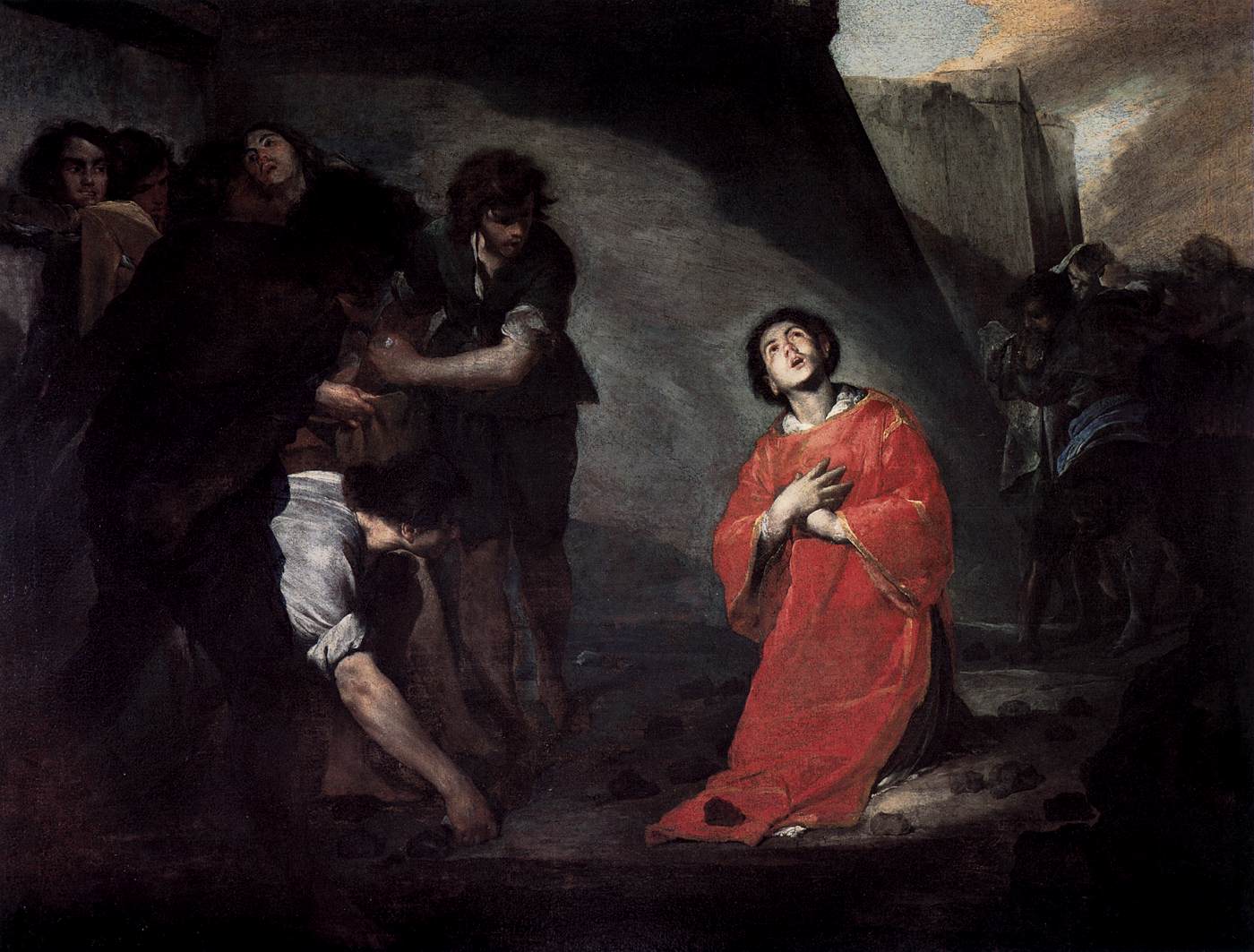
“Martyrdom of St. Stephen”
by Bernardo Cavallino, 1660’s
 
Readings for the Feast of St. Stephen [1]
 
Readings from the Jerusalem Bible [2]
 
Readings and Commentary: [3]
 
Reading 1: Acts 6:8-10; 7:54-59
 
Stephen, filled with grace and power,
was working great wonders and signs among the people.
Certain members of the so-called Synagogue of Freedmen,
Cyrenians, and Alexandrians,
and people from Cilicia and Asia,
came forward and debated with Stephen,
but they could not withstand the wisdom and the spirit with which he spoke.
 
When they heard this, they were infuriated,
and they ground their teeth at him.
But he, filled with the Holy Spirit,
looked up intently to heaven
and saw the glory of God and Jesus standing at the right hand of God,
and he said,
“Behold, I see the heavens opened and the Son of Man
standing at the right hand of God.”
But they cried out in a loud voice, covered their ears,
and rushed upon him together.
They threw him out of the city, and began to stone him.
The witnesses laid down their cloaks
at the feet of a young man named Saul.
As they were stoning Stephen, he called out
“Lord Jesus, receive my spirit.”
-------------------------------------------
Commentary on Acts 6:8-10; 7:54-59
 
The evangelist tells the story of how St. Stephen, one of the first deacons selected by the apostles, was martyred. It was St. Luke’s intent to provide an image of St. Stephen as being similar to Christ.  The charges leveled against him were similar.  He uttered blasphemies against Moses and God; he spoke out against the temple and the law; and professed Jesus of Nazareth as the Messiah and asserted the temple would be destroyed.
 
A prime reason this event is so momentous for the Church is not just the fact that St. Stephen, a Greek, was the first martyr following Christ’s crucifixion, but this marked the crisis within Jerusalem with regard to Christianity.  The result was a clear fingerprint of God’s plan.  The persecution had the unintended consequence of pushing the Word out of Jerusalem to Samaria, Judea, Galilee, and Syria. [4]
 
It is interesting to note that the "Saul," at whose feet the cloaks were laid, is our own St. Paul, who before his conversion was a talented prosecutor of Christians.
 
CCC: Acts 7:56 659
-------------------------------------------
Responsorial Psalm: Psalm 31:3cd-4, 6 and 8ab, 16bc and 17
 
R. (6) Into your hands, O Lord, I commend my spirit.
 
Be my rock of refuge,
a stronghold to give me safety.
You are my rock and my fortress;
for your name’s sake you will lead and guide me.
R. Into your hands, O Lord, I commend my spirit.
 
Into your hands I commend my spirit;
you will redeem me, O Lord, O faithful God.
I will rejoice and be glad because of your mercy.
R. Into your hands, O Lord, I commend my spirit.
 
Rescue me from the clutches of my enemies and my persecutors.
Let your face shine upon your servant;
save me in your kindness.
R. Into your hands, O Lord, I commend my spirit.
-------------------------------------------
Commentary on Ps 31:3cd-4, 6 and 8ab, 16bc and 17
 
This is an individual lament. The section links nicely to the death of martyrs with “Into your hands I commend my spirit” and “You hide them in the shelter of your presence from the plottings of men.” The psalmist gives us a song of faith very appropriate for the one who is put to the test for their faith. It is a prayer for rescue and a submission of will to God's saving power.
 
-------------------------------------------
Gospel: Matthew 10:17-22
 
Jesus said to his disciples:
“Beware of men, for they will hand you over to courts
and scourge you in their synagogues,
and you will be led before governors and kings for my sake
as a witness before them and the pagans.
When they hand you over,
do not worry about how you are to speak
or what you are to say.
You will be given at that moment what you are to say.
For it will not be you who speak
but the Spirit of your Father speaking through you.
Brother will hand over brother to death,
and the father his child;
children will rise up against parents and have them put to death.
You will be hated by all because of my name,
but whoever endures to the end will be saved.”
-------------------------------------------
Commentary on Mt 10:17-22
 
Jesus gives his disciples instructions on how to deal with the persecution they are to undergo at the hands of those who do not accept him, especially those in power. His instruction is one that relies on faith that the Father, through the Holy Spirit, will supply the words. There is also a presumption that there will be loss of life. Here the Lord tells us that those who are steadfast in their faith cannot die a spiritual death.
 
“Jesus does not so much caution his disciples against men, in the sense of declaring mankind (οί άυθϱωποι) to be the natural enemies of his disciples and, hence, of himself.  Rather, he appears to be warning them against becoming like the rest of men, against fighting violence with violence rather than with the truth, against reacting to contempt and hatred with contempt and hatred rather than with transformative and imaginative love.” [5]
 
"Here, the hostility the apostles will face comes into sharp focus.  They are being sent out like sheep in the midst of wolves - an image of vulnerability and helplessness before fierce attackers.  Yet the apostles are not to be passive when enemies assail them. They are to be as shrewd as serpents, prudently anticipating threats and finding ways to survive. But they must at the same time be as simple as doves. The word for simple means 'unmixed,' suggesting that the apostles' shrewd tactics should be animated by pure motives and single-mindedness for their ministry. Shrewdness should never lead them to seek survival or advantage in a way that compromises their integrity."  [6]
 
CCC: Mt 10:19-20 728; Mt 10:22 161, 1821
-------------------------------------------
Reflection:
 
"'It is clear', St. Ephraem comments, 'that those who suffer for Christ enjoy the glory of the whole Trinity. Stephen saw the Father and Jesus at His side, because Jesus appears only to his own, as was the case with the Apostles after the Resurrection. While the champion of the faith stood there helpless in the midst of those who had killed the Lord, just at the point when the first martyr was to be crowned, he saw the Lord, holding a crown in His right hand, as if to encourage him to conquer death and to show that he inwardly helps those who are about to die on his account. He therefore reveals what he sees, that is, the heavens opened, which were closed to Adam and only opened to Christ at the Jordan, but open now after the Cross to all who share Christ's sufferings, and in the first instance open to this man. See how Stephen reveals why his face was lit up: it was because he was on the point of contemplating this wondrous mission. That is why he took on the appearance of an angel--so that his testimony might be more reliable, (Armenian Commentary, ad loc.)." [7]
 
Each year, on the day following Christmas, the Church begins a series of celebrations called the “Christmas Companions.” The first of these celebrates the Feast of St. Stephen. The Gospel of St. John used at the Christmas Mass during the day tells us that the Word incarnate will be rejected by those who are his own (John 1:10).  In today’s Gospel, the Lord cautions his followers that they too will face rejection, persecution, and possibly death.  With the glow of the Morning Star that illuminated the manger still warming our hearts, we are given a stern reminder of what discipleship means.
 
For the Order of Deacons (the diaconate), this day is very special. St. Stephen, the first martyr, is also one of the first deacons, ordained by the apostles to serve the Church. His feast day is the day upon which we celebrate the establishment of the diaconate. Since all ordained clergy in the Church (deacons, priests, and bishops) are ordained to that rank and order, this is a very important day in the life of the Church as a whole.
 
In Scripture today we are given selections that tell us of the unique connection between Jesus, the apostles, and those first seven deacons, most especially St. Stephen. Upon him and the other six, hands were imposed, dedicating them to the service of the poor and marginalized members of the faith community. We hear the story of how St. Stephen was put to death for essentially the same reason as the Lord. He was proclaiming the good news in a way that infuriated the Hebrew leadership.
 
God’s plan can sometimes only be seen in retrospect.  In this case, the martyrdom of St. Stephen marked the beginning of a great persecution of Christians in Jerusalem which drove many faith-filled Christians out of Jerusalem to Samaria, Judea, Galilee, and Syria. Instead of killing the spread of Christianity, the zealot Jews of Jerusalem cooperated with God’s plan, and using the Roman Empire’s great transportation system, pushed the Word into the known world.  St. Stephen was the spark that caused God’s Son’s work to spread as only pure truth can.
 
We see the irony of the participation of Saul (later St. Paul, who also died a martyr's death) in the condemnation and execution of St. Stephen. One must wonder if St. Stephen's words did not, in some way, pave the path for St. Paul’s later conversion.
 
We hear in the psalm a prayer for strength in the face of persecution, and we are given in the Gospel words of encouragement by Jesus.  He tells us: "whoever endures to the end will be saved.”  We must expect the same kind, if not the same degree, of resistance in our own Christian witness based upon what the Lord tells us earlier in that same verse: "You will be hated by all because of my name." It is ironic that we are now called “haters” by many of those who reject Christian morality.
 
On this great feast of the Church, let us give thanks to God for the gift of all his saints, especially St. Stephen, martyr and deacon. Let us also give thanks to all those throughout history who have laid down their lives for the faith and pray that we can be courageous and follow in their steps.
 
Pax

[1] The picture today is “Martyrdom of St. Stephen” by Bernardo Cavallino, 1660’s.
[2] S.S. Commemoratio
[3] The readings are taken from the New American Bible, with the exception of the psalm and its response which were developed by the International Committee for English in Liturgy (ICEL). This republication is not authorized by USCCB and is for private use only.
[4] Jerome Biblical Commentary, Prentice Hall, Inc., © 1968, 45:37, p. 182.
[5] Fire of Mercy Heart of the Word Volume I, Erasmo Leiva-Merikakis, Ignatius Press, San Francisco, CA, © 1996 p. 554.
[6] The Gospel of Matthew, © 2010 Curtis Mitch and Edward Sri, Baker Academic, Grand Rapids, MI, p. 145.
[7] The Navarre Bible, “Gospels and Acts,” Scepter Publishers, Princeton, NJ, © 2002, p. 763.