Saturday, July 06, 2019

Fourteenth Sunday in Ordinary Time


Catechism Links[1]
CCC 541-546: The Kingdom of God is at hand
CCC 787, 858-859: The Apostles, united to the mission of Christ
CCC 2122: “The laborer deserves his food”
CCC 2816-2821: “Your kingdom come”
CCC 555, 1816, 2015: The Cross as the way to follow Christ

“The Seventy Disciples are Sent out Two by Two” by James Tissot, 1886-96


Commentary:

Reading 1: Isaiah 66:10-14c

Commentary on Is 66:10-14c

In this selection from what is known as deutero-Isaiah (written after the Israelites returned following the Babylonian exile - 539 BC), Isaiah speaks metaphorically to those returning from exile. They hear of the creation (birth without pain) of God’s children in a New Jerusalem. He uses the image of a mother nursing her child as an image of God's loving care for the people he has called home.  His oracle relates to a time of prosperity that comes about due to God’s love for those he has created. It is a calling home, a call to return to that place that gave them birth.

CCC: Is 66:13 239, 370
---------------------------------------------------------------------
Responsorial Psalm: Psalm 66:1-3, 4-5, 6-7, 16, 20

R. (1) Let all the earth cry out to God with joy.


Psalm 66 is a song of thanksgiving. As it continues, the selection starts with part of the whole community blessing the Lord, and follows in the second and third strophes with individual responses to the communal prayer. In the final strophe, v.20, we see the usual action of the person who has been rescued coming forward to teach the community what God has done.

---------------------------------------------------------------------
Reading II: Galatians 6:14-18

Commentary on Gal 6:14-18

St. Paul, in this selection, tells the Galatians that the Good News of Christ (and Him crucified) is for all people, not just for those who came from the Jewish tradition (“For neither does circumcision mean anything, nor does uncircumcision, but only a new creation”). He then tells his audience that, not through the ancient marks of branding does he belong to Christ, but through the marks of his persecution (from stonings and beatings).

CCC: Gal 6:15 1214
---------------------------------------------------------------------

Commentary on Lk 10:1-12, 17-20

It is only in Luke’s Gospel that we find the sending of the 72.  This event is supported in other non-biblical accounts of the period (see Eusebius of Caesarea (c. 265-c. 340)  - Church History).  It is noteworthy that the instructions given to these disciples are very similar to those given to the twelve in Luke 22:35.  As the 72 return, the Lord reminds them that the power they have demonstrated over the forces of evil (“even the demons are subject to us because of your name”) is a consequence of their adoption (“your names are written in heaven”) not some personal merit or natural ability.

This selection emphasizes Jesus' early struggle to accomplish what he came to do by himself. We sense his humanness as he says: "The harvest is abundant but the laborers are few," We also find this event and statement in St. Matthew’s Gospel, where, instead of the 72, he names the 12 (Matthew 10:1-8). While in St. Matthew’s story Jesus sends them first to the Hebrew people, St. Luke makes no such distinction.

This effort by Jesus was modeled on Moses’ leadership structure in which 70 elders were appointed (Numbers 11:24-25). It is also possible that the reference number, 70, relates to the number of nations mentioned in Genesis 10. The disciples were sent two by two, a custom that would be replicated later in the post-resurrection missionary activities of the Church (see Acts 8:14; 15:39-40).

In another historical similarity, the disciples were sent without possessions, presumably depending upon the traditionally required hospitality for their support. Similar instructions were given by the Prophet Elisha as he sent his servant in 2 Kings 4:29.

The Lord’s instructions concerning hospitality, “laborer deserves his payment,” is also quoted in St. Paul’s first letter to Timothy (1 Timothy 5:18b), and has further support in 1 Corinthians 9:7, 14. Those who labor on behalf of the Gospel, and cannot take time to support themselves, deserve the support of the community. In a final twist, the Lord’s instruction, to “eat what is set before you,” sets aside Mosaic dietary laws (also 1 Corinthians 10:27 and Acts 10:25). It is a clear indication that the scope of their mission is to call all peoples to the Gospel.

CCC: Lk 10:1-2 765; Lk 10:2 2611; Lk 10:7 2122; Lk 10:17-20 787
---------------------------------------------------------------------
OR: (Shorter Form) Luke 10:1-9

Commentary on Lk 10:1-9

It is only in Luke’s Gospel that we find the sending of the 72.  This event is supported in other non-biblical accounts of the period (see Eusebius of Caesarea (c. 265-c. 340)  - Church History).  It is noteworthy that the instructions given to these disciples are very similar to those given to the twelve in Luke 22:35.

This shorter form omits the consequences spelled out for those who reject the messengers.  It also omits the account of the success of these emissaries, bringing to sharper focus the shared mission to proclaim the Gospel of Christ to all (note: Jesus does not, as St. Matthew reports, send them just to the Jewish population.).

CCC: Lk 10:1-2 765; Lk 10:2 2611; Lk 10:7 2122
---------------------------------------------------------------------
Homily

Living in the information age, we receive so many messages and so much information each day it is difficult to keep our own issues and challenges in focus.  We are affected by, not just local issues, new taxes, problems facing schools and infrastructure (roads), but we have instant access to news, events, and images from around the world.  The natural rhythm of our lives has reached a pace our forebears could not have imagined.  When the Declaration of Independence was signed those 240 years ago, the news of that event would have taken weeks and months to reach the ears of the people in the thirteen colonies.  Had something of that magnitude taken place today, it would have been seen live by anyone on the earth who cared to see it.

It is easy to become caught up in the web technology has thrown over our human interactions, so that we forget that there is a purpose in life beyond being blown about here and there by things that occur in the net of over-communication that exists in our modern society.  With the advent of electronic social networking, social norms of behavior have been challenged as they have never been in the past.  The most intimate details of individual thoughts, dreams, and desires are blasted out to multitudes who echo and amplify the basic human condition, unfettered by social morals that encourage modesty, chastity, and spiritual grace.  The attack is pervasive, instantaneous, and relentless.

As our Bishops have reminded us, this social noise attempts to establish a new norm for morality in our country.  The uninhibited expression of disrespect for human dignity (ironically called bullying when it is used among the young in our society) is now being used against anyone who does not subscribe to the amoral code being pushed by those who would disregard natural law when it comes to marriage, and disregard human life when it comes to contraception, abortion, and sterilization.  They call us bigots because we cling to our Christian morality, and “haters” if we reject compromising our long established belief in the natural law supported by sacred scripture.

And here we sit, in this Holy Space, being sent from here like “like lambs among wolves.”  We come together in worship to be strengthened by Word, Sacrament, and a shared mission.  Whether we accept it or not, our membership in this faith community requires that we take the message of Christ into a world that is virtually seething with counter messages.  The generation coming up cannot imagine being surprised to hear of an event that took place a week, or even a day ago.  They will know instantly of any influence anywhere in the world that affects them.  Without a filter, the filter of faith we can help them develop, they will be at the mercy of those who would claim them for the world.

So what do we do?  Electronic communication is everywhere.  It’s not just radio or TV, it’s not even computers. The smart phones of today reach into every part of the world, and the messages and images from the world are not necessarily positive influences.  Even adults can be lured into areas of information they should avoid. 

The first thing we do is discipline ourselves.  New technology requires new discipline.  The availability of information can lead us into temptation in the modern age, temptation to greed, to lust, and to disregard human dignity and life.  Ironically the forces that lead us in these directions are guaranteed by the very document signed in Pennsylvania those centuries ago that hoped to preserve life and human dignity.  It is so pervasive we have to work to avoid it.  Our values of freedom of religion are challenged like never before, while the rights of those who would demean the human person are held up as symbols of modern open-mindedness.

We are called, as Christ’s modern disciples, to go into the world bearing the Gospel message.  We are challenged by the Lord to accept the task he hands us.  We witness first to our families and friends, then to our associates, school mates and co-workers, and finally to any with whom we have contact.  We must be confident that we are well equipped to take on this mission.  The Lord has called us: he sends us, he asks us only to do what we can to make his message of love and forgiveness known.  We pray for the strength and wisdom to take up the task of the 72 whom he sent and who came back rejoicing at their victory.

Pax


[1] Catechism links are taken from the Homiletic Directory, published by the Congregation for Divine Worship and the Discipline of the Sacraments, 29 June 2014.
[2] The picture is “The Seventy Disciples are Sent out Two by Two” by James Tissot, 1886-96.


Friday, July 05, 2019

Saturday of the Thirteenth Week in Ordinary Time

(Optional Memorial for Saint Maria Goretti, Virgin and Martyr) Or
(Optional Memorial for the Blessed Virgin Mary)


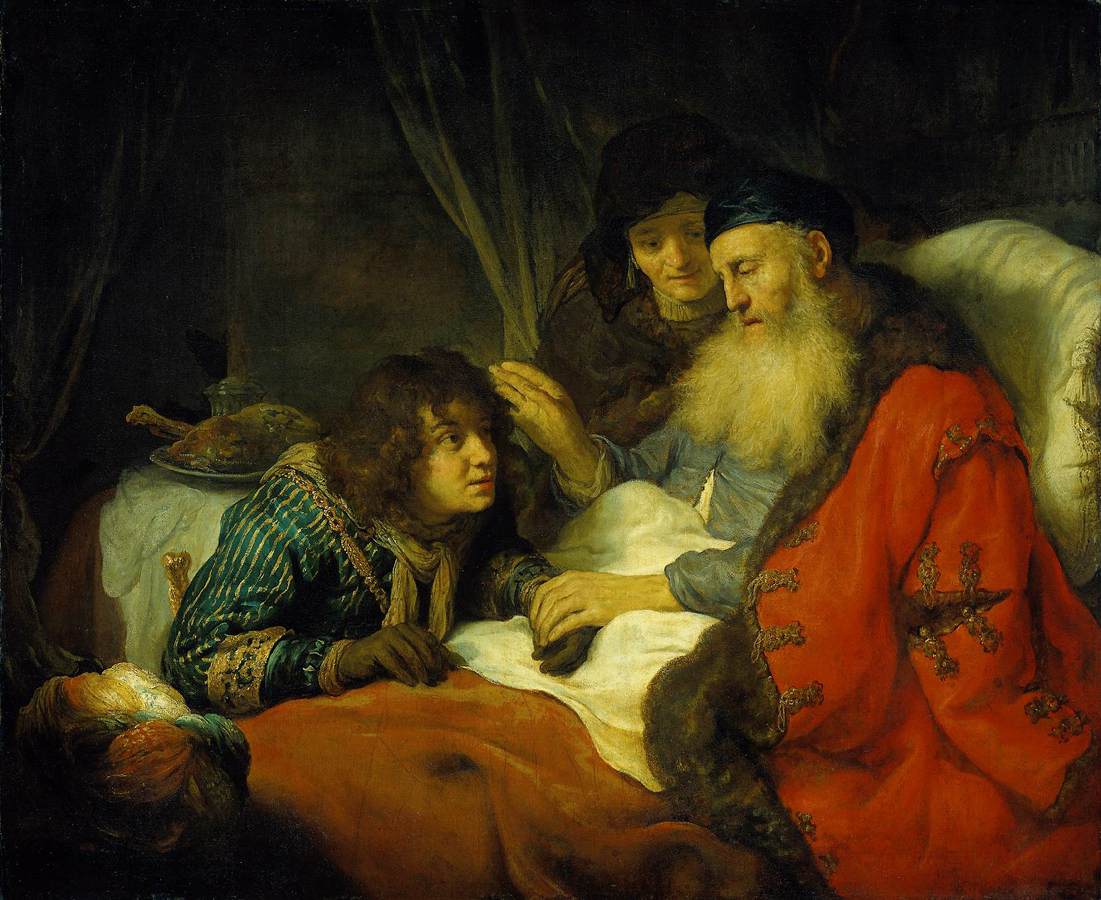
“Isaac Blessing Jacob” by Govert Teunisz Flinck, 1639


Commentary:


Commentary on Gn 27:1-5, 15-29

This passage brings us to Isaac’s deathbed. In this selection we hear the plot of Rebecca and Jacob to trick Isaac into giving his final blessing to Jacob, cheating his twin brother Esau out of it. "Here too, as in the case of Isaac (cf. Genesis 21:8-13), the part played by the mother is stressed; she ignores custom, and plays an active part in the furthering of God's plans. The passage also stresses how shrewd the patriarch is by comparison with Esau. Jacob's action is justified in the overall context of the narrative, given that he bought the birthright previously from his brother." [5]

 While nothing is said in this passage as to the morality of the means by which Jacob receives this inheritance, his action is condemned in other parts of scripture (see Hosea 12:3 and Jeremiah 9:3). God punishes them for this act by separating Jacob and his mother. This action shows how God takes even the weak and undeserving and uses them to his greater glory.

---------------------------------------------------------------------
Responsorial Psalm: Psalm 135:1b-2, 3-4, 5-6

R. (3a) Praise the Lord for the Lord is good!
or:
R. Alleluia.

Commentary on Ps 135:1b-2, 3-4, 5-6

Psalm 135 is a song of praise and thanksgiving. The reference in the second strophe is to God choosing Jacob, which he did at the birth of the twins telling his mother: “the older shall serve the younger.”

CCC: Ps 135:6 269
---------------------------------------------------------------------
Gospel: Matthew 9:14-17

Commentary on Mt 9:14-17

Jesus is approached by St. John the Baptist’s disciples about the Pharisaic practices of ritual fasting. In Old Testament usage this action was a token of repentance or of mourning. No fast is actually prescribed in the Law of Moses, except the fast on the Day of Atonement (Leviticus 16:29 and 23:27 and Numbers 29:7). Given this understanding of the Law of Moses, what was being practiced by the Pharisees (and St. John’s disciples) was tradition. Jesus' response, "Can the wedding guests mourn as long as the bridegroom is with them,” speaks to the fact that his disciples do not have anything to repent from or mourn for, as long as they are following him.

The next section of the reading seems to contradict an earlier statement of Jesus (Matthew 5:17-20), when he said he had not come to abolish the Law (of Moses) but to fulfill it. But, his metaphors about the wineskins and the cloth refer to a completely new understanding of God’s revelation that cannot be a “patchwork” of ideas, rather a consistent application of Christ’s law of love, mercy, and hope.

---------------------------------------------------------------------
Reflection:

We reflect today upon the cautionary message embedded in the Gospel of St. Matthew.  In the passage given, the Lord is challenged by some of the disciples of St. John the Baptist (of which at least one of his own disciples, Andrew, was formerly a member).  They ask why Jesus and his disciples do not practice the Pharisaic traditions of ritual fasting.  Jesus, also of the Pharisaic tradition, was not following their scrupulous rules and neither were his disciples.  It was important that Jesus strike just the right tone in his reply.  Recognizing that the Pharisees were following a tradition developed out of their understanding of the Law (not prescriptions of the Law), he explains that his disciples do not need to mourn or repent while he is with them (coming as he does to fulfill the law and the prophets - we understand this).

Where, one may ask is the cautionary message here?  Jesus is defending his disciples' actions because what they do, they do out of understanding.  They understand that they do not fast because the Son of God is with them and they cannot mourn while he is present.  The Pharisees and St. John’s disciples have forgotten the underlying spiritual reason for what they do and focus on the actions of their worship instead of upon the reason for those actions.  In other words, the actions themselves become important rather than the spiritual driver that caused them to be enacted in the first place.

In a faith so rich in ritual and tradition, we can sometimes fall into the same trap.  Our focus might be on the ritual or tradition and we might forget that the reason we do what we do is for God’s greater glory, not simply following the rules or rubrics.  We are reminded by this gospel story that when we do the ritual things of our faith, be they as simple as making the sign of the cross or genuflecting, or as complex as the rosary or the Divine Mercy devotionals, we recall the underlying reasons for what we do at each step.

Today we thank God for giving us his word and the means to worship him through our faith.  We also pray that when we participate with our brothers and sisters in the practice of that faith we focus on the spiritual aspects of what we do as well as the rubrics of the faith.

Pax


[1] General Norms for the Liturgical Year and the Calendar Miscellaneous Notes no. 5: “Outside Advent, Christmas Time, Lent, and Easter Time, on Saturdays which have no commemoration having the rank of Obligatory Memorial or higher, a Mass in honor of the Blessed Virgin Mary may be celebrated. This is indicated in the calendar by “BVM.” The readings and prayers may be selected from the Collection of Masses of the Blessed Virgin Mary.”
[2] The picture is “Isaac Blessing Jacob” by Govert Teunisz Flinck, 1639.
[3] S.S. Commemoratio (Saturday of the 13th Week in Ordinary Time)

[5] The Navarre Bible: “Pentateuch”, Scepter Publishers, Princeton, NJ, © 2003, p. 139.

Thursday, July 04, 2019

Friday of the Thirteenth Week in Ordinary Time

(Optional Memorial for Saint Elizabeth of Portugal) 
– in the United States perpetually transferred from July 4 Or
(Optional Memorial for Saint Anthony Zaccaria, Priest)


“Meeting of Isaac and Rebecca”
by Giovanni Benedetto Castiglione, c. 1640


Commentary:


The various excerpts from Chapters 23 and 24 of Genesis tell the story of the death of Sarah and Abraham’s successful plan to obtain a wife for his son Isaac from the Hebrew community. This passage explains how Rebekah (Rebecca) comes to be Isaac’s wife, and how God’s promise to Abraham, that his line would endure, is fulfilled as Isaac continues to enjoy God’s graces and favor.

CCC: Gn 23:4 145
---------------------------------------------------------------------
Responsorial Psalm: Psalm 106:1b-2, 3-4a, 4b-5

R. (1b) Give thanks to the Lord, for he is good.

Commentary on Ps 106:1b-2, 3-4a, 4b-5

Psalm 106 is a song of thanksgiving. In this selection the singer thanks God for his saving mercy and favor to his chosen people. This hymn of praise rejoices over God’s gracious help to those who trust in him. We see clearly the hand of God guiding the faithful as the psalmist proclaims “That I may see the prosperity of your chosen ones, rejoice in the joy of your people, and glory with your inheritance.”

---------------------------------------------------------------------
Gospel: Matthew 9:9-13

Commentary on Mt 9:9-13

The journey of Jesus continues with the Lord’s encounter with Matthew (Levi in St. Mark’s Gospel), the tax collector. The Pharisees are scandalized because this renowned teacher (Jesus) has chosen to associate with “sinners,” who clearly violate some of the numerous laws about ritual purity (Matthew 5:46). Jesus’ response, “I desire mercy, not sacrifice,” makes it clear that interior faith is more highly prized than purely ritualistic rigor.

This passage is the call of St. Matthew into discipleship. His profession, as customs worker or tax collector, would have stimulated controversy among the scribes and Pharisees, and the presence of others of the same type at the meal described, would have caused ritual impurity. However, as with his disciples, Peter, Andrew, James, and John, Jesus calls Matthew as he was engaged in his profession. The question the Pharisees ask, because such contact would have caused ritual impurity, would have been construed as a critical remark. The Lord responded with a challenge, quoting Hosea 6:6, and punctuated his response with the observation that those who were critical of his associations did not understand the scriptures they professed to represent.

CCC: Mt 9:12 581; Mt 9:13 589, 2100
---------------------------------------------------------------------
Reflection:

We were given the Reader’s Digest version of Abraham’s response to the death of Sarah, his first wife, and the procurement of Rebecca as wife for his son Isaac.  What was left out of the story was the fact that those involved (the servant, Rebecca and Rebecca’s family) were all guided by God and gave praise to him at each new stage of the story.  We were not shown the faith of the servant who prayed for a sign from God, that the girl Rebecca was the one sent for Isaac by God, nor were we shown the faith of Rebecca, as she prayed for guidance in going with the servant.  The entire saga, with the parts we did not hear today, is a story of faith and submission to the will of God.

The psalm used paints the larger picture of God’s gracious mercy to those who follow him.  It essentially pulls the moral from the story for us, and leads to the Gospel, as Jesus chooses to dine with the “sinners” rather than eat in the ritualistically pure environment of the Pharisees.  The Lord makes it clear that it is more important for him to reach out to those who need his spiritual example than it is for him to follow the ritually complex rules of the Pharisaic laws.  That he calls Matthew should be great news for us who, though unworthy of God’s grace, also are called to serve the Lord.

By these examples we see the importance of our own interior faith and how it must be developed and applied in the world.  Is the implication here the one that so many of the “unchurched” use to rationalize their lack of participation in organized religion?  Is the message that the formal celebration of the faith is unimportant? 

No, that is not the message.  The message, which was intended for and can only be truly understood by the organized community of faith represented by the Church, tells us that our call must be to reach out as well as maintain an interior faith, strengthened by the sacraments.

Pax


[1] The picture is “Meeting of Isaac and Rebecca” by Giovanni Benedetto Castiglione, c. 1640.