Friday, July 12, 2019

Saturday of the Fourteenth Week in Ordinary Time

(Optional Memorial for Saint Henry) Or
(Optional Memorial for the Blessed Virgin Mary)

On Saturdays in Ordinary Time when there is no obligatory memorial, an optional memorial of the Blessed Virgin Mary is allowed.[1] Mass texts may be taken from the Common of the Blessed Virgin Mary, from a Votive Mass, or from the special collection of Masses for the Blessed Virgin Mary. (USCCB recommends: #42 The Blessed Virgin Mary, Help of Christians )


“Abraham, Isaac, and Jacob”; 
iconifer and date are unknown.


Commentary


Commentary on Gn 49:29-32; 50:15-26a

In the passage from Genesis today we hear the final chapters of the life of Jacob and then Joseph. We see, following the death of Jacob, the fidelity of Joseph to God’s rule as he forgoes any thoughts of retribution against those brothers of his who had sold him into slavery. God’s plan was clearly revealed and the actions of Joseph’s brothers were forgiven. The line of Abraham continues as Joseph, on his death bed, predicts the Exodus from the land of Egypt to come. (“God will surely take care of you and lead you out of this land to the land that he promised on oath to Abraham, Isaac and Jacob.")

CCC: Gn 50:20 312
---------------------------------------------------------------------
Responsorial Psalm: Psalm 105:1-2, 3-4, 6-7

R. (see Psalm 69:33) Be glad you lowly ones; may your hearts be glad!

Commentary on Ps 105:1-2, 3-4, 6-7

Psalm 105 is a song of thanksgiving. In this section, the singer gives thanks to God for the tradition of Abraham’s descendants and the salvation that is shown through their story.

CCC: Ps 105:3 30
---------------------------------------------------------------------

Commentary on Mt 10:24-33

Jesus concludes his instructions to the Apostles as he sends them out. Here he tells them that they go with his authority and his purpose, which may be hidden from others, but which they will proclaim from “the housetops.” He tells them not to fear the persecution he has told them they will face. Fear should be absent, because while the body may be killed, their souls are safe with him. He concludes this passage telling them that the Father is watching over them, and they have nothing to fear.

CCC: Mt 10:25 765; Mt 10:25 765; Mt 10:28 363, 1034; Mt 10:29-31 305; Mt 10:32-33 1816; Mt 10:32 14, 2145
---------------------------------------------------------------------
Reflection:

Today in St. Matthew’s Gospel we find the paradox of our faith clearly exemplified. We are, like the friends of Jesus (his disciples), called to him and sent into the world. Like the Twelve, we are uncertain and feel unworthy to accept this great task. On top of our feelings of inadequacy, we are afraid. What if we fail to speak the right words? What if we are rebuffed and rejected? What if our very mission brings us into a situation where we can be physically harmed?

These feelings were all present in the disciples. To calm those fears, Jesus explains to them that, going in his Name, they go with his authority. In addition, the Lord points out that they should not fear physical harm. First, they should not fear it because the important part of who they are is safe from any harm. They (we) belong to him and our spirits are thus guarded from eternal death which should be their (and our) greatest fear. They are also told that since they go in the Lord’s Name, the Father watches over them and will keep them from harm.

As we see in Genesis as God’s plan for Jacob and Joseph comes to a close, God will watch over us as he did our brothers and sisters gone before us in faith. The great covenant made with Abraham has been overshadowed by Christ’s covenant with us – the New Covenant. Through that Covenant a promise was made, that we who love God and our neighbors as Christ taught us would not perish.

We are called and sent like the first disciples of Christ. We go into the world now to carry the good news especially to those who live in darkness. May we never fear in this effort, confident that God is with us, watching over us. In him is our strength and hope.

Pax


[1] General Norms for the Liturgical Year and the Calendar Miscellaneous Notes no. 5: “Outside Advent, Christmas Time, Lent, and Easter Time, on Saturdays which have no commemoration having the rank of Obligatory Memorial or higher, a Mass in honor of the Blessed Virgin Mary may be celebrated. This is indicated in the calendar by “BVM.” The readings and prayers may be selected from the Collection of Masses of the Blessed Virgin Mary.”
[2] The Icon is “Abraham, Isaac, and Jacob”; iconifer and date are unknown.


Thursday, July 11, 2019

Friday of the Fourteenth Week in Ordinary Time


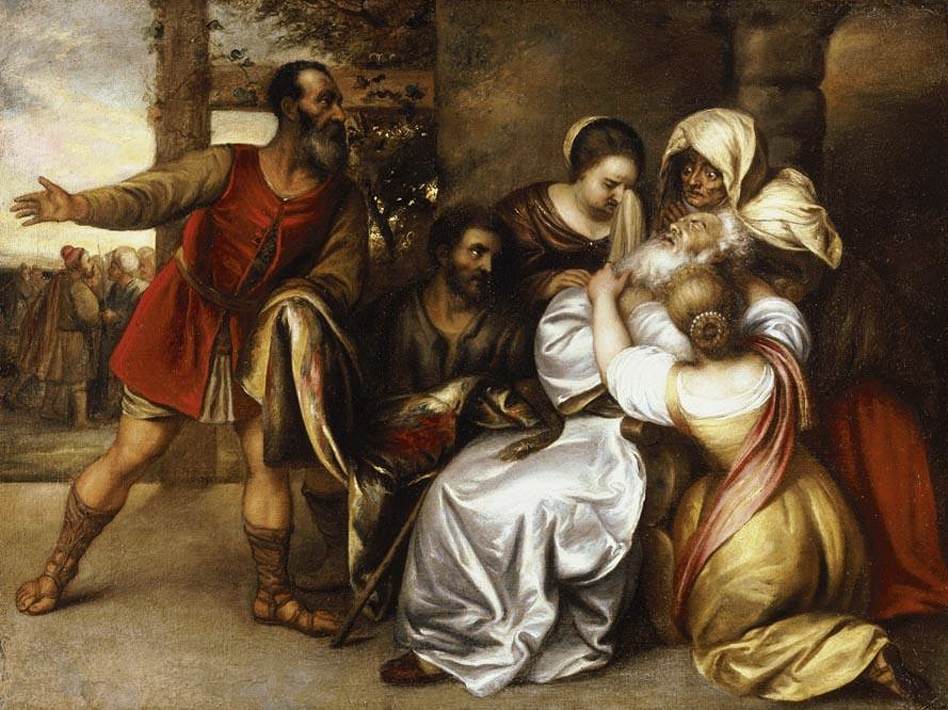
“Jacob Receiving the Bloody Tunic of Joseph” Jan Lievens, c. 1660


Commentary:


Commentary on Gn 46:1-7, 28-30

"Jacob goes down to Egypt forced by the famine which is ravaging the land of Canaan (cf. Genesis 47:4). The Lord has prepared the way for him by means of a series of painful events and a series of tests whose meaning is now plain to see." [4]

“Jacob's status is not reduced by his going into Egypt; on the contrary, it is enhanced and underlined: 'For, what does he need if God goes with him? [...] Who is as powerful in his homeland as Jacob was in a strange country? Who had such abundance of wealth, as he had in a time of famine? Who was as strong in his youth, as this man was in his old age? [...] Who was as rich in his kingdom, as this man on his pilgrimage? He even blessed kings [...], and who will call him poor whom the world was not worthy to know? for his company was in heaven, (St. Ambrose, ‘De Iacob Et Vita Beata', 2, 9. 38)." [5]

After being told years earlier that his son Joseph had been killed and been shown the bloodied coat he had given Joseph (
Genesis 37:20-36), Jacob (Israel) and his son are reunited and the promise of God is fulfilled. Jacob travels to Egypt on God’s reassurance that he will not only be returned to the land he had been given, but that Joseph would “close his eyes,” a burial ritual.

---------------------------------------------------------------------
Responsorial Psalm: Psalm 37:3-4, 18-19, 27-28, 39-40

R. (39a) The salvation of the just comes from the Lord.


This didactic selection from Psalm 37 promises the salvation of those who hear God’s voice and trust in him.  Central to this passage is the fidelity of God to those who are faithful.  Salvation for them is assured if they trust in him and take refuge in their faith. The author responds to the question: why do the wicked prosper? In these strophes, it continues the plea to be faithful to God, and remain steadfast in the time of adversity. The psalmist adds that those who turn away should return and God will give them salvation.

---------------------------------------------------------------------

Commentary on Mt 10:16-23

Jesus concludes his instruction to the Apostles in this selection from Matthew’s Gospel. We begin to hear about the persecutions that attend the spreading of the Gospel. Those who spread that Good News are encouraged not to worry about an apologia (defense), but rather to trust in the Holy Spirit, the Father “speaking through you.”

Matthew’s final statement, referring to the coming of the Son of Man, has a couple of possible explanations. First it could be referring to the return of Christ after his crucifixion. It could also mean the punishment of the unbelieving Jewish people by the destruction of the temple by the Romans in 70 AD.

CCC: Mt 10:16 764; Mt 10:19-20 728; Mt 10:22 161, 1821
---------------------------------------------------------------------
Reflection:

“See how they love one another.” (While this sounds biblical it is actually popularized form of a quote from Tertullian’s noted Apologia [39.6] written in the third century.)  The implication is that non-Christians would be able to identify us by the way we behave toward one another (and others as well, since the injunction to love one’s neighbor does not simply mean other Christians).  This action of “loving one another” is an outward sign of an interior faith.  There are a number of factors that must be present before we demonstrate to the world that we are Christian through our actions.

In the story unfolding in Genesis we see Jacob (Israel) challenged to give up his belief in God’s love and mercy by the events taking place in his life.  He was led to believe by his sons that his favored son, Joseph, had been killed.  In spite of this evidence of his eyes, God promised Jacob he would see Joseph again before he died.  What elevates Jacob to the status of patriarch of the faith is that, even though he had been convinced that Joseph was dead, he believed God’s promise.  His faith was strong in the face of overwhelming physical evidence to the contrary.

In St. Matthew’s Gospel Jesus warns the disciples that they will have their faith tested as well.  He tells them “I am sending you like sheep in the midst of wolves.”  Indeed, all but one of the twelve will be killed by those to whom they are sent.  In all cases, the Apostles are elevated to that same holy status as Jacob, all save one – Judas.  Judas’ failure was not that he turned Jesus over to be executed.  His failure was that he negotiated on a key point of faith.  He could not accept that Jesus was meant to fulfill the prophecy of the Messiah in the way he ultimately did, through humble service.

As in these two examples (Jacob and the disciples), each of us also faces challenges to our faith.  Like Judas, we are offered the option of negotiating the core values that make us Christian.  We can choose an easier path, ignoring the poor and marginalized, choosing our own comfort over the greater good of our neighbors, selfishness over generosity.  These choices face us each day. We pray for the intercession of those who have gone before us in faith. May we be steadfast in our love of God and neighbor, thereby maintaining our friendship with Christ.

Pax


[1] The picture is “Jacob Receiving the Bloody Tunic of Joseph” Jan Lievens, c. 1660.

[4] The Navarre Bible: “Pentateuch”, Scepter Publishers, Princeton, NJ, © 2003, p. 212.
[5] The Navarre Bible: “Pentateuch”, Scepter Publishers, Princeton, NJ, © 2003, pp. 213-14.

Wednesday, July 10, 2019

Memorial of Saint Benedict, Abbot


“Saint Benedict” by Fra Angelico,1387


Commentary:


Joseph punishes his bothers for having sold him into slavery by tricking them into bringing Benjamin their youngest brother, who had taken Joseph’s place as the apple of his father’s eye. When he confronts them and sees their willingness to protect and save Benjamin, he reveals himself to them. Joseph tells his brothers that, in selling him to Egypt, they did God’s will since through him many lives were saved.

---------------------------------------------------------------------
Responsorial Psalm: Ps 105:16-17, 18-19, 20-21

R. (5a) Remember the marvels the Lord has done.
or:
R. Alleluia.


Psalm 105 is a historical hymn that recalls, in this selection, the Genesis story (Genesis 37:3ff), speaking of the fate of Joseph in Egypt and how God rescued and supported him in his slavery. It also recounts the actions of Joseph’s brothers, selling him into slavery in Egypt and speaks of the rise of Joseph in the house of Pharaoh.

---------------------------------------------------------------------
Gospel: Matthew 10:7-15

Commentary on Mt 10:7-15

The instructions to the Apostles, as Jesus sends them on their mission to proclaim the kingdom of God, are given. They are to go into the world without any provisions, and will depend upon the generosity of others. The Lord gives them authority over all manner of diseases and afflictions, but reminds them that they are not to request payment for these gifts of healing.

The Lord's instructions end with a warning to those who reject the proclamation of the kingdom of God.  Jesus tells the Apostles that those who reject the peace they offer will suffer, as those cut off from God's grace by the judgment laid upon the ones who perished in the destruction of Sodom and Gomorrah (see Genesis 19:1-26).

CCC: Mt 10:5-7 543; Mt 10:8 1509, 2121, 2443; Mt 10:10 2122
---------------------------------------------------------------------
Homily:

"What eye has not seen, and ear has not heard, and what has not entered the human heart, what God has prepared for those who love him" (1 Corinthians 2:9). St. Paul paraphrases the Prophet Isaiah (Isaiah 64:3, 65:16) with these words and summarizes the lesson we take from sacred scripture at numerous points.  We see evidence of how this comes to pass in the story that continues to unfold in Genesis.

We are all familiar with the story of the sons of Jacob, how they sold their brother Joseph into slavery, and then told their father he had been killed.  In the first reading, we hear how their actions, as ignoble as they were, were used by God for the salvation of many, including those envious and mean-spirited brothers. 

The scenario has a familiar ring to it, does it not?  Even in our own lives, don’t we have a saying that “God never closes a door but that he opens a window?”  In this case God has set Joseph in a place where he can dispense food to those who might otherwise starve due to famine.  (If we really want to get twisted around we could ask: “Did God cause the famine so the brothers of Joseph would be forced to ask him for food, thereby exposing their evil deed and bringing salvation to Jacob at the same time?")  It is frequently the case that when we attempt to understand God’s plan, we find ourselves questioning his motives (look at the passion of Christ for example).  At some point, it is better to look at the end results and see how it all fits together.

The lesson of faith we learn is again summarized in St. Paul’s statement: we cannot conceive of what God has planned for us.  We are called to accept the following:  First, we accept that God loves us and has given us what we need to accomplish his will.  Second, he created us for a reason; he gives our lives purpose.

One of those “purposes” is implied in the Gospel from St. Matthew.  We are called by Christ and we are sent, armed with the Holy Spirit, into the world to proclaim the Good News.  It may be by word spoken or example lived, but it goes hand in hand with the call we received with our baptism, confirmed in the Holy Spirit, and reaffirmed in the Eucharist we share.

There may be those among us who say: “But I cannot do this.  I am shy or I am too old or too young or weak.”  We come back once more to St. Paul’s use of Isaiah’s prophecy. We cannot know God’s ultimate purpose, any more than Joseph did when he was sold into slavery, or the Apostles did when they were called away from their fishing nets. We do not know what God has prepared for those who love him.  In that love, we can only accept his call and marvel at the wondrous deeds he brings to pass.

Pax


[1] The picture is “Saint Benedict” by Fra Angelico,1387.