Friday, May 19, 2023

Saturday of the Sixth Week of Easter

(Optional Memorial for Saint Bernardine of Siena, Priest)
“The Prayer in the Garden” (detail)
by 
Tintoretto, 1578-81
 
Readings for Saturday of the Sixth Week of Easter [1]
 
Readings from the Jerusalem Bible [2]
 
Readings and Commentary: [3]
 
Reading 1: Acts 18:23-28
 
After staying in Antioch some time,
Paul left and traveled in orderly sequence
through the Galatian country and Phrygia,
bringing strength to all the disciples. 
 
A Jew named Apollos, a native of Alexandria,
an eloquent speaker, arrived in Ephesus.
He was an authority on the Scriptures.
He had been instructed in the Way of the Lord and,
with ardent spirit, spoke and taught accurately about Jesus,
although he knew only the baptism of John.
He began to speak boldly in the synagogue;
but when Priscilla and Aquila heard him,
they took him aside
and explained to him the Way of God more accurately.
And when he wanted to cross to Achaia,
the brothers encouraged him
and wrote to the disciples there to welcome him.
After his arrival he gave great assistance
to those who had come to believe through grace.
He vigorously refuted the Jews in public,
establishing from the Scriptures that the Christ is Jesus.
-------------------------------------------
Commentary on Acts 18:23-28
 
The story in Acts introduces Apollos who, like St. Paul, continues the rapid spreading of the Gospel. He is clearly an educated Jewish convert (to the “Way”) from Alexandria. Hearing the story unfold, we learn much about him. Note he only had the “baptism of John (the Baptist).” This means that he must have been in Galilee earlier.
 
We also know that Apollos later becomes a revered leader in the Christian Community. We hear St. Paul speak of him in his First Letter to the Corinthians (1 Corinthians 1:12; 3:5-6, 3:22).
 
CCC: Acts 18:18 2102
-------------------------------------------
Responsorial Psalm: Psalm 47:2-3, 8-9, 10
 
R. (8a) God is king of all the earth.
or:
R. Alleluia.
 
All you peoples, clap your hands;
shout to God with cries of gladness.
For the LORD, the Most High, the awesome,
is the great king over all the earth.
R. God is king of all the earth.
or:
R. Alleluia.
 
For king of all the earth is God;
sing hymns of praise.
God reigns over the nations,
God sits upon his holy throne. 
R. God is king of all the earth.
or:
R. Alleluia.
 
The princes of the peoples are gathered together
with the people of the God of Abraham.
For God's are the guardians of the earth;
he is supreme. 
R. God is king of all the earth.
or:
R. Alleluia.
-------------------------------------------
Commentary on Ps 47:2-3, 8-9, 10
 
Psalm 47 is a hymn of praise. It calls all nations to acknowledge the kingship of God. The singer proclaims his belief that the God of Abraham is the creator, the one true God, who reigns over the earth. The song becomes an apologetic exhortation against idols of foreign gods.
 
-------------------------------------------
Gospel: John 16:23b-28
 
Jesus said to his disciples:
"Amen, amen, I say to you,
whatever you ask the Father in my name he will give you.
Until now you have not asked anything in my name;
ask and you will receive, so that your joy may be complete.
 
"I have told you this in figures of speech.
The hour is coming when I will no longer speak to you in figures
but I will tell you clearly about the Father.
On that day you will ask in my name,
and I do not tell you that I will ask the Father for you.
For the Father himself loves you, because you have loved me
and have come to believe that I came from God.
I came from the Father and have come into the world.
Now I am leaving the world and going back to the Father."
-------------------------------------------
Commentary on Jn 16:23b-28
 
This selection is taken from Jesus’ farewell speech. In this passage Jesus makes a strong connection between his own identity and the Father’s (“whatever you ask the Father in my name he will give you”).
 
From a dogmatic perspective, this section of St. John’s Gospel sets the precedent as to how we are instructed to pray (e.g. to God through the Son, Jesus). He makes it clear that they are to use his name in prayer to the Father and assures them that what they ask for in his name will be given.
CCC: Jn 16:23-27 2615; Jn 16:24 2615, 2815; Jn 16:26 2815; Jn 16:28 661, 2795
-------------------------------------------
Reflection:
 
Because of the importance of the Gospel message today, we reflect upon why it is important to be a people of prayer. Jesus tells his disciples that, “Until now you have not asked anything in my name.” That statement would seem to indicate that, up to that point, like Jesus himself, they had been praying to God without the understanding that the Son and the Father are one, and “no one comes to the Father” except through the Son.
 
Today he establishes the flow of prayer, from us to God, through Christ. That concept has been faithfully passed down to us through the successors of St. Peter from the earliest times of the Church. It is clouded only slightly by our equally rich understanding of the Trinity, three persons, one God. In formula, however, we conclude our prayer with: “through Christ our Lord.” Or: “We ask this through our Lord Jesus Christ who lives and reigns with you and the Holy Spirit, God, forever and ever.” 
 
We take great pains to contrast the persons to whom our prayer is directed because, with our enormous faith tradition, we have so many intercessors. Chief among those we turn to is Mary the Mother of God and Queen of Heaven, asking her to intercede for us with her Son. Likewise, with the whole communion of saints at our disposal, we ask frequently for intercession from those holy men and women whom we believe reside in the new Jerusalem, the heavenly kingdom, with the angels and surrounding the throne of the Lamb.
 
We ask the Father for so much, don’t we? We always seek his support and guidance, his gifts of grace, and salvation. We were taught to be a people of prayer, and we must come to understand what that means if we are to follow Christ more closely. Our most common failing in prayer is forgetting to listen. We talk to God, we plead with God, and we beseech his Son to come to our aid. We ask for his intervention in events and, in our darkest despair, we ask him to undo what has been done. 
 
When do we listen? As a people who ask for God’s help through His Son, we should be doing more listening than talking. Listening is the most difficult part of prayer, that seeming silence where we strain to hear and struggle to understand if it is our voice or God’s that tries to fill the void created by the absence of our own words. 
 
Today, as we reflect upon God’s great gift of his Only Begotten Son, and how gracious he was in his promise that what we prayed for in his name would be done for us by his Father, let us spend more time watching for the fulfillment of those prayers and listening for the answers to our questions. And when answers come, let us give thanks and praise to him, something else our prayer frequently fails to do.
 
Pax
 

[1] The picture used is “The Prayer in the Garden” (detail) by Tintoretto, 1578-81.
[2] S.S. Commemoratio
[3] The readings are taken from the New American Bible, with the exception of the psalm and its response which were developed by the International Committee for English in Liturgy (ICEL). This republication is not authorized by USCCB and is for private use only.

Thursday, May 18, 2023

Friday of the Sixth Week of Easter


“Resurrection”
by Luca Giordano after 1665
 
Begin the Pentecost Novena to the Holy Spirit
 
Readings for Friday of the Sixth Week of Easter [1]
 
Readings from the Jerusalem Bible [2]
 
Readings and Commentary: [3]
 
Reading 1: Acts 18:9-18
 
One night while Paul was in Corinth, the Lord said to him in a vision,
"Do not be afraid.
Go on speaking, and do not be silent, for I am with you.
No one will attack and harm you,
for I have many people in this city."
He settled there for a year and a half
and taught the word of God among them.
 
But when Gallio was proconsul of Achaia,
the Jews rose up together against Paul
and brought him to the tribunal, saying,
"This man is inducing people to worship God contrary to the law."
When Paul was about to reply, Gallio spoke to the Jews,
"If it were a matter of some crime or malicious fraud,
I should with reason hear the complaint of you Jews;
but since it is a question of arguments over doctrine and titles
and your own law, see to it yourselves.
I do not wish to be a judge of such matters."
And he drove them away from the tribunal.
They all seized Sosthenes, the synagogue official,
and beat him in full view of the tribunal.
But none of this was of concern to Gallio.
 
Paul remained for quite some time,
and after saying farewell to the brothers he sailed for Syria,
together with Priscilla and Aquila.
At Cenchreae he had shaved his head because he had taken a vow.
-------------------------------------------
Commentary on Acts 18:9-18
 
The setting of this selection is part of St. Paul’s stay in Corinth.  There is a strong link that existed between the Jewish faith and Christianity in this early period of the development of the Church. The proconsul, Gallio, a Roman, rejected the charges of the Jewish leadership against Paul, saying that it was an internal affair of the Jewish religion. Christianity continues to flourish in spite of resistance, receiving help in this instance from Rome herself. This example demonstrates the role the Roman Empire, with its transportation system and laws designed to facilitate the incorporation of conquered territories into itself, played in the rapid spread of Christianity.
 
CCC: Acts 18:18 2102
-------------------------------------------
Responsorial Psalm: Psalm 47:2-3, 4-5, 6-7
 
R. (8a) God is king of all the earth.
or:
R. Alleluia.
 
All you peoples, clap your hands,
shout to God with cries of gladness,
For the LORD, the Most High, the awesome,
is the great king over all the earth.
R. God is king of all the earth.
or:
R. Alleluia.
 
He brings people under us;
nations under our feet.
He chooses for us our inheritance,
the glory of Jacob, whom he loves.
R. God is king of all the earth.
or:
R. Alleluia.
 
God mounts his throne amid shouts of joy;
the LORD, amid trumpet blasts.
Sing praise to God, sing praise;
sing praise to our king, sing praise.
R. God is king of all the earth.
or:
R. Alleluia.
-------------------------------------------
Commentary on Ps 47:2-3, 4-5, 6-7
 
Psalm 47 is a prayer of thanksgiving and praise. It acclaims God king in all the earth. This selection focuses on the omnipotence of God over all peoples and nations.
 
-------------------------------------------
Gospel: John 16:20-23
 
Jesus said to his disciples:
"Amen, amen, I say to you, you will weep and mourn,
while the world rejoices;
you will grieve, but your grief will become joy.
When a woman is in labor, she is in anguish because her hour has arrived;
but when she has given birth to a child,
she no longer remembers the pain because of her joy
that a child has been born into the world.
So you also are now in anguish.
But I will see you again, and your hearts will rejoice,
and no one will take your joy away from you.
On that day you will not question me about anything.
Amen, amen, I say to you,
whatever you ask the Father in my name he will give you."
-------------------------------------------
Commentary on Jn 16:20-23
 
In this passage there is an analogy used by Jesus. It compares the Lord's death and resurrection to the initiation of new life through the human birth process. Jesus uses this comparison to contrast the pain of childbirth with the anguish of grief the disciples will suffer when he leaves them to return to the Father. He concludes by comforting them saying, “whatever you ask the Father in my name he will give you.”
 
CCC: Jn 16:23-27 2615
-------------------------------------------
Reflection:
 
For those of us who have doubts about our faith at times, the passage proclaimed from St. John’s Gospel is a real comfort.  Jesus is continuing his farewell speech to the disciples. He undoubtedly sees how distressed they are becoming over his explanation that he will be leaving them.  In spite of the picture generally painted in St. John’s Gospel, of the disciples understanding and accepting Jesus’ nature and role, in this instance, as he tells them he is leaving, they are clearly having some problems understanding just how he is going to be present to them in the resurrection.
 
He first explains that initially there will be the grief of parting as he leaves this world and goes back to the Heavenly Kingdom.  But this grief will be forgotten when he is reunited with them, first in his resurrection, and then in the Holy Spirit he will leave them as a guide.  He uses the analogy of giving birth to a child, and how the joy experienced in the life that results from the birthing process overshadows the pain the mother suffers.  He tells them that, at this time (this speech is part of his discourse at the Last Supper), they are afraid of what is to come, and, having understood that he will soon be leaving, they are in pain.  But there is rejoicing to come, and the pain they are feeling will be forgotten. (A father speaking to his child might say – “Don’t cry, I will be right back.”)
 
The passage concludes with a promise that “whatever you ask the Father in my name he will give you."  The clear implication to the disciples is that even in the parting that will come; the Lord will still be present and active.  If this were not so, how could he make that promise?
 
The problem we face sometimes is that our attitudes are like the family pet that is left at home.  Once the door closes and their master is no longer visible, they start whimpering because they want to go too, or are concerned that their master will not return.  Jesus promises that we will be reunited with those who have gone before us in faith.  He pledges the Father’s love and the joy of the Heavenly Kingdom.  On that day, even our most persistent doubts will be put to rest as the Lord tells us: “On that day you will not question me about anything.”
 
In the intervening time, our instructions are ironically similar to those left with a child by their parents when they leave for a short time (and although it can be construed as a bit demeaning, to a pet as the master leaves) “Be good, I’ll be right back.”
 
Pax
 

[1] The picture used today is, “Resurrection” by Luca Giordano after 1665.
[2] S.S. Commemoratio
[3] The readings are taken from the New American Bible with the exception of the Psalm and its response which were developed by the International Committee for English in Liturgy (ICEL). This re-publication is not authorized by USCCB and is for private use only.

Wednesday, May 17, 2023

Thursday of the Sixth Week of Easter

(Optional Memorial for Saint John I, Pope, Martyr)

“The Ascension”
by Tintoretto, 1579-81
 
Readings for Thursday of the Sixth Week of Easter [2]
 
Readings from the Jerusalem Bible [3]
 
Readings and Commentary: [4]
 
Reading 1: Acts 18:1-8
 
Paul left Athens and went to Corinth.
There he met a Jew named Aquila, a native of Pontus,
who had recently come from Italy with his wife Priscilla
because Claudius had ordered all the Jews to leave Rome.
He went to visit them and, because he practiced the same trade,
stayed with them and worked, for they were tentmakers by trade.
Every sabbath, he entered into discussions in the synagogue,
attempting to convince both Jews and Greeks.
When Silas and Timothy came down from Macedonia,
Paul began to occupy himself totally with preaching the word,
testifying to the Jews that the Christ was Jesus.
When they opposed him and reviled him,
he shook out his garments and said to them,
“Your blood be on your heads!
I am clear of responsibility.
From now on I will go to the Gentiles.”
So he left there and went to a house
belonging to a man named Titus Justus, a worshiper of God;
his house was next to a synagogue.
Crispus, the synagogue official, came to believe in the Lord
along with his entire household, and many of the Corinthians
who heard believed and were baptized.
-------------------------------------------
Commentary on Acts 18:1-8
 
This passage contains the threads from several different stories converging in Corinth. First, Aquila and Priscilla were probably already Christians since their home, according to 1 Corinthians 16:19, became a meeting place for the local community. They were probably expelled from Rome because of infighting among the Jews about the identity of the Messiah.
 
It is clear from this account that the church in Corinth was not established without significant resistance from the local Jewish community. Paul went after that group and was successful in forming the nucleus of membership among the Corinthians.
 
CCC: Acts 18:6 597; Acts 18:8 1252, 1655
-------------------------------------------
Responsorial Psalm: Psalm 98:1, 2-3ab, 3cd-4
 
R. (see 2b) The Lord has revealed to the nations his saving power.
or:
R. Alleluia.
 
Sing to the LORD a new song,
for he has done wondrous deeds;
His right hand has won victory for him,
his holy arm.
R. The Lord has revealed to the nations his saving power.
or:
R. Alleluia.
 
The LORD has made his salvation known:
in the sight of the nations he has revealed his justice.
He has remembered his kindness and his faithfulness
toward the house of Israel.
R. The Lord has revealed to the nations his saving power.
or:
R. Alleluia.
 
All the ends of the earth have seen
the salvation by our God.
Sing joyfully to the LORD, all you lands;
break into song; sing praise.
R. The Lord has revealed to the nations his saving power.
or:
R. Alleluia.
-------------------------------------------
Commentary on Ps 98:1, 2-3ab, 3cd-4
 
Psalm 98 is a song of praise and thanksgiving. We see in this selection how God is praised for the strength he lends his people, and the salvation he brings to those who are faithful. The psalm rejoices in God’s salvation. The Lord has revealed his compassion toward the people, and they sing his praises in response. The Hebrews saw this as salvation for the people of Israel from its enemies. Christians see the deeper expression of God’s love, as he sent his Son for salvation and justice for the whole world.
 
This is an excellent example of how Christians, heirs to the Judeo-Christian truth, can see clearly in these ancient texts the references to the Christ: “The Lord has made his salvation known.” It is this event about which we “sing joyfully to the Lord.”
 
-------------------------------------------
Gospel: John 16:16-20
 
Jesus said to his disciples:
“A little while and you will no longer see me,
and again a little while later and you will see me.”
So some of his disciples said to one another,
“What does this mean that he is saying to us,
'A little while and you will not see me,
and again a little while and you will see me,’
and 'Because I am going to the Father’?”
So they said, “What is this 'little while’ of which he speaks?
We do not know what he means.”
Jesus knew that they wanted to ask him, so he said to them,
“Are you discussing with one another what I said,
'A little while and you will not see me,
and again a little while and you will see me’?
Amen, amen, I say to you,
you will weep and mourn, while the world rejoices;
you will grieve, but your grief will become joy.”
-------------------------------------------
Commentary on Jn 16:16-20
 
In spite of Jesus’ repeated attempts, the disciples are still uncertain about his departure and how long he will be gone. Since they have already heard what the prophets had predicted about the length of time he would be in the tomb and had heard the Lord himself give the number of three days, they are concerned here about when he will return to them after the resurrection. The Lord, in characteristic form, does not give them a specific time frame, but instead paints a picture of the events surrounding his return.
 
-------------------------------------------
Reflection:
 
The message of St. John’s Gospel is one of hope. That short statement, “you will grieve, but your grief will become joy,” sums up the Christian experience and expectation.  Have we not all questioned at times why life seemed so unfair?  Haven’t there been times when we have all wondered at God’s purpose in giving us the life he has so graciously bestowed upon us?  In these times of doubt and pain, we grieve for the hurts of life, hurts we receive, and hurts visited upon others.
 
Out of these questions, in answer to them, comes Jesus, who is the Christ (as St. Paul reminds us in his evangelization of the Corinthians).  Jesus, in no uncertain terms, tells us that while we may mourn and grieve in this life, wait but a time, and we will rejoin him in his heavenly kingdom.  He tells us that while we may be parted for a time, we will be joined to him eternally in the life of heaven.
 
It is this message of hope, communicated in our time on earth by the Advocate he left for us, that we must recall in times of strife or grief.  We look within to find the strength of the Holy Spirit to buoy us up and bring us knowledge of his great consolation.  This great prize is what we have received.  This interior hope (peace) is what allows us to continue against all the trials that are put into our lives.
 
What must we do to tap into this indwelling strength, this pillar of hope?  We listen to his word and find in Sacred Scripture that which feeds our spirit of holiness.  We speak to God in prayer, and he opens our core of strength.  We receive the sacraments of the Church, which provide graces specific to each that sing in harmony with the voice of Scripture, and the warmth of prayers answered.  All these things are open to us, gifts left by him who is parted from us only for a short while.  All we need to do is ask and believe, and we will be given the great prize of eternal life.
 
Pax
 
[1] In all but six ecclesiastical provinces in the United States (Boston, Hartford, New York,
Newark, Omaha, and Philadelphia), the Solemnity of the Ascension is celebrated on the Seventh
Sunday of Easter.
[2] The picture used today is “The Ascension” by Tintoretto, 1579-81.
[3] S.S. Commemoratio
[4] The readings are taken from the New American Bible, with the exception of the psalm and its response which were developed by the International Committee for English in Liturgy (ICEL). This republication is not authorized by USCCB and is for private use only.

Tuesday, May 16, 2023

Wednesday of the Sixth Week of Easter


“God the Father with the Holy Spirit and Angels”
by Bartholomaeus Spranger c. 1582
 
Readings for Wednesday of the Sixth Week of Easter [1]
 
Readings from the Jerusalem Bible [2]
 
Readings and Commentary: [3]
 
Reading 1: Acts 17:15, 22—18:1
 
After Paul's escorts had taken him to Athens,
they came away with instructions for Silas and Timothy
to join him as soon as possible.
 
Then Paul stood up at the Areopagus and said:
"You Athenians, I see that in every respect
you are very religious.
For as I walked around looking carefully at your shrines,
I even discovered an altar inscribed, 'To an Unknown God.'
What therefore you unknowingly worship, I proclaim to you.
The God who made the world and all that is in it,
the Lord of heaven and earth,
does not dwell in sanctuaries made by human hands,
nor is he served by human hands because he needs anything.
Rather it is he who gives to everyone life and breath and everything.
He made from one the whole human race
to dwell on the entire surface of the earth,
and he fixed the ordered seasons and the boundaries of their regions,
so that people might seek God,
even perhaps grope for him and find him,
though indeed he is not far from any one of us.
For 'In him we live and move and have our being,'
as even some of your poets have said,
'For we too are his offspring.'
Since therefore we are the offspring of God,
we ought not to think that the divinity is like an image
fashioned from gold, silver, or stone by human art and imagination.
God has overlooked the times of ignorance,
but now he demands that all people everywhere repent
because he has established a day on which he will 'judge the world
with justice' through a man he has appointed,
and he has provided confirmation for all
by raising him from the dead."
 
When they heard about resurrection of the dead,
some began to scoff, but others said,
"We should like to hear you on this some other time."
And so Paul left them.
But some did join him, and became believers.
Among them were Dionysius,
a member of the Court of the Areopagus,
a woman named Damaris, and others with them.
After this he left Athens and went to Corinth.
-------------------------------------------
Commentary on Acts 17:15, 22—18:1
 
This selection places St. Paul in Athens speaking to the pagans in one of their principal venues. In his rhetoric, he uses their own beliefs to bring them to understanding by first telling them, using their “Unknown God” as a starting point, that God is not bound in gold, silver, or stone (as their idols are), but that he exists all around them, creator of all that is and will be.
 
When he gets to a point at which he begins talking about Jesus and the Lord’s resurrection, he loses most of them, but some remain and Christianity in that city has begun. From Athens he and his companions move to Corinth.
 
CCC: Acts 17:24-29 287; Acts 17:26-28 28; Acts 17:26-27 57; Acts 17:26 360; Acts 17:27-28 32; Acts 17:27 2566; Acts 17:28 300; Acts 17:31 679; Acts 17:32 996
-------------------------------------------
Responsorial Psalm: Psalm 148:1-2, 11-12, 13, 14
 
R. Heaven and earth are full of your glory.
or:
R. Alleluia.
 
Praise the LORD from the heavens;
praise him in the heights.
Praise him, all you his angels;
praise him, all you his hosts.
R. Heaven and earth are full of your glory.
or:
R. Alleluia.
 
Let the kings of the earth and all peoples,
the princes and all the judges of the earth,
Young men too, and maidens,
old men and boys.
R. Heaven and earth are full of your glory.
or:
R. Alleluia.
 
Praise the name of the LORD,
for his name alone is exalted;
His majesty is above earth and heaven.
R. Heaven and earth are full of your glory.
or:
R. Alleluia.
 
He has lifted up the horn of his people;
Be this his praise from all his faithful ones,
from the children of Israel, the people close to him.
Alleluia.
R. Heaven and earth are full of your glory.
or:
R. Alleluia.
-------------------------------------------
Commentary on Ps 148:1-2, 11-12, 13, 14
 
Psalm 148 is a hymn of praise. In this selection, we find the psalmist (presumably King David) singing of the omnipotence of God, his power and majesty, and his promise of salvation. This poem is related to the Benedicite, or “Song of the Three Children,” in Daniel 3:52-90. In both, we find catalogs of natural phenomena praising God. [4]
 
-------------------------------------------
Gospel: John 16:12-15
 
Jesus said to his disciples:
"I have much more to tell you, but you cannot bear it now.
But when he comes, the Spirit of truth,
he will guide you to all truth.
He will not speak on his own,
but he will speak what he hears,
and will declare to you the things that are coming.
He will glorify me,
because he will take from what is mine and declare it to you.
Everything that the Father has is mine;
for this reason I told you that he will take from what is mine
and declare it to you."
-------------------------------------------
Commentary on Jn 16:12-15
 
Jesus’ farewell speech continues.  His reference to the coming of the Holy Spirit is explained further, and the unity of the Holy Trinity comes into focus. The Lord tells his friends that this Advocate will give them what is also his (the Lord’s). He tells the disciples that the Holy Spirit will not bring new revelations but will allow them to understand the things that have already happened. And in that revelatory understanding, Christ will be glorified because he and the Father are one.
 
CCC: Jn 16:13-15 2615; Jn 16:13 91, 243, 687, 692, 1117, 2466, 2671; Jn 16:14-15 485; Jn 16:14 244, 690
-------------------------------------------
Reflection:
 
Any skill or craft may look simple or easy on the surface.  Take the making of a table, what is there to it?  It will have legs and a top.  How simple is that?  Yet great carpenters will know what kind of wood to use.  They know what tools will be needed and how to use them and those tools will change depending on the size of the piece to be built and the complexity of its design.  True artists of the craft will take a lifetime to perfect their skill.
 
Apply that same idea to Jesus’ farewell to his disciples being described in St. John’s Gospel.  He tells them straight out: “I have much more to tell you, but you cannot bear it now.”  Although he is a young man by our standards, in his early 30s, he is going to meet his passion and death.  With this statement it appears that his disciples have figured out what Jesus is saying and are understandably distraught.
 
While we do not know exactly how old his friends are, we do know they have a huge task in front of them.  They are to take the Good News to the world.  As they do so, principally because of the gift of the Holy Spirit to be received on Pentecost, they will understand more of what they cannot understand at the moment of this telling.
 
It is like this with us as well.  Who among us did not grow up with our parents telling us about Jesus, and how we needed to love him and be loved by him?  That very simplistic understanding was what we could grasp at the early phase of our relationship to him.  As we grew older, we began to understand better what it meant to love the Lord and be loved by him.  And now, as we recall the words of St. John once more, we see how far we have come and know that, like the disciples, we have a long way yet to go.
 
Today we give thanks for our relationship to the risen Lord, and we ask for the guidance of the Holy Spirit to take us further as we truly come to understand all that God will let us understand before we meet him face to face.
 
Pax
 
[1] The picture used today is “God the Father with the Holy Spirit and Angels” by Bartholomaeus Spranger c. 1582.
[2] S.S. Commemoratio
[3] The readings are taken from the New American Bible, with the exception of the psalm and its response which were developed by the International Committee for English in Liturgy (ICEL). This republication is not authorized by USCCB and is for private use only.
[4] Jerome Biblical Commentary, Prentice Hall, Inc., © 1968, 35:164, p. 601.

Monday, May 15, 2023

Tuesday of the Sixth Week of Easter


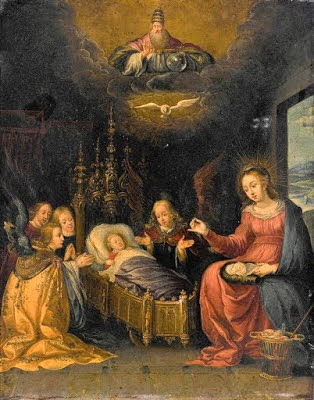
“Madonna and Child with God the Father,
the Holy Spirit and Adoring Angels”
by Pieter Lisaert III, c. 1590s
 
Readings for Tuesday of the Sixth Week of Easter [1]
 
Readings from the Jerusalem Bible [2]
 
Readings and Commentary: [3]
 
Reading 1: Acts 16:22-34
 
The crowd in Philippi joined in the attack on Paul and Silas,
and the magistrates had them stripped
and ordered them to be beaten with rods.
After inflicting many blows on them,
they threw them into prison
and instructed the jailer to guard them securely.
When he received these instructions, he put them in the innermost cell
and secured their feet to a stake.
 
About midnight, while Paul and Silas were praying
and singing hymns to God as the prisoners listened,
there was suddenly such a severe earthquake
that the foundations of the jail shook;
all the doors flew open, and the chains of all were pulled loose.
When the jailer woke up and saw the prison doors wide open,
he drew his sword and was about to kill himself,
thinking that the prisoners had escaped.
But Paul shouted out in a loud voice,
"Do no harm to yourself; we are all here."
He asked for a light and rushed in and,
trembling with fear, he fell down before Paul and Silas.
Then he brought them out and said,
"Sirs, what must I do to be saved?"
And they said, "Believe in the Lord Jesus
and you and your household will be saved."
So they spoke the word of the Lord to him and to everyone in his house.
He took them in at that hour of the night and bathed their wounds;
then he and all his family were baptized at once.
He brought them up into his house and provided a meal
and with his household rejoiced at having come to faith in God.
-------------------------------------------
Commentary on Acts 16:22-34
 
This selection is another part of the first of the “we” sections in Acts. Here the events of Paul and Silas being beaten, jailed, and then released are given. Most scholars point to the anti-Jewish mentality of the crowd and the leadership (magistrates) at the beginning of this passage (v. 22).  Their harsh treatment and conditions of their confinement appear to be a reaction to the fear of St. Paul's reputed power (“and instructed the jailer to guard them securely. When he received these instructions, he put them in the innermost cell and secured their feet to a stake").  The earthquake that followed apparently confirmed this worry and at least the jailer was so convinced that he converted instantly.
 
"This is the first time St Paul comes into conflict with Gentiles. As might be expected, the incident does not take the form of a riot, as happened in cities of Asia Minor (13:50; 14:5, 19), but of a civil suit before local magistrates. The people who bring the charge say nothing about their real reason  ̶  loss of profit. They accuse Paul of two things. Their first charge is disturbance of the peace. The second seems to be based on regulations forbidding Roman citizens to practice alien cults, especially where these conflict with Roman custom." [4]
 
The jailer and those present interpreted the earthquake and its effect on the jail cells as a sign from God. This gave weight to Paul’s evangelical approach that led to their release and the jailer’s conversion.
 
CCC: Acts 16:31-33 1226; Acts 16:31 1655; Acts 16:33 1252
-------------------------------------------
Responsorial Psalm: Psalm 138:1-2ab, 2cde-3, 7c-8
 
R. (7c) Your right hand saves me, O Lord.
or:
R. Alleluia.
 
I will give thanks to you, O LORD, with all my heart,
for you have heard the words of my mouth;
in the presence of the angels I will sing your praise;
I will worship at your holy temple,
and give thanks to your name.
R. Your right hand saves me, O Lord.
or:
R. Alleluia.
 
Because of your kindness and your truth,
you have made great above all things
your name and your promise.
When I called, you answered me;
you built up strength within me.
R. Your right hand saves me, O Lord.
or:
R. Alleluia.
 
Your right hand saves me.
The LORD will complete what he has done for me;
your kindness, O LORD, endures forever;
forsake not the work of your hands.
R. Your right hand saves me, O Lord.
or:
R. Alleluia.
-------------------------------------------
Commentary on Psalm 138:1-2ab, 2cde-3, 7c-8
 
Psalm 138 is a psalm of thanksgiving. It contains the same sense as if it were a continuation of the prayer of Esther C:12, 14-16, 23-25. It praises God for his saving works and expresses confidence in his saving help. It also supports the rescue of Paul and Silas (Acts 16:22ff) who prayed and whose prayers were answered by divine intervention. (“When I called, you answered me.”)
 
CCC: Ps 138 304; Ps 138:2 214
-------------------------------------------
Gospel: John 16:5-11
 
Jesus said to his disciples:
"Now I am going to the one who sent me,
and not one of you asks me, 'Where are you going?'
But because I told you this, grief has filled your hearts.
But I tell you the truth, it is better for you that I go.
For if I do not go, the Advocate will not come to you.
But if I go, I will send him to you.
And when he comes he will convict the world
in regard to sin and righteousness and condemnation:
sin, because they do not believe in me;
righteousness, because I am going to the Father
and you will no longer see me;
condemnation, because the ruler of this world has been condemned."
-------------------------------------------
Commentary on Jn 16:5-11
 
"Jesus speaks about the Holy Spirit three times during the discourse of the Last Supper. The first time (John 14:15ff), He says that another Paraclete (advocate, consoler) will come, sent by the Father, to be with them forever; secondly, He says (John 14:26) that He Himself will send them, on behalf of the Father, the Spirit of truth who will teach them everything; and now He unfolds for them the complete plan of salvation and announces that the Holy Spirit will be sent once He ascends into Heaven." [5]
 
In this selection Jesus reemphasizes that he is returning to the Father and it is only when he does so that the Paraclete will be given to the disciples. Above the active support and guidance promised to be given by the Advocate earlier, we now hear of its role as judge. This movement from “guide” to “judge” demonstrates the completeness of this person of the Trinity.
 
CCC: Jn 16:11 385
-------------------------------------------
Reflection:
 
There are a number of paradoxes we face as living as Christians in a secular world.  We are to be of the world but separate from it; we are to love our enemies, and while we are to live in a world that is not bound by Christian values, we are told to “Stop judging, that you may not be judged” (Matthew 7:1).
 
Still, if we are to live in the world we must make judgments each day about what course of action to take in given situations. And even the most idealistic person finds that many of these judgments fall into what can only be called “a gray area” as opposed to black or white.  What are we to do?  How are we supposed to decide which course of action is best?
 
It was for precisely this reason that Jesus left us the Holy Spirit, the Advocate, as St. John says in the Gospel passage today.  The Advocate is an indwelling Spirit of holiness conferred in baptism and sealed in confirmation.  The Advocate provides us with access to God’s wisdom and it is through this access we are to chart our course for our lives in the world.
 
There is, of course, some difficulty for most of us surrounding the appropriate use of the Holy Spirit as counselor and guide.  It is like the stereotype applied to men driving to a destination to which they have never been and getting turned around.  According to the stereotypical assessment – they will not stop and ask for directions except as a last resort (ignoring, out of pride, the wisdom of their wives' advice to do so).  We tend to do the same thing in life.  We do not ask for (or perhaps more significantly, listen to) the help of the Holy Spirit when making our decisions.  It is, after all, difficult to tap into that source of wisdom, especially if it is not a regular practice and even more especially because it requires listening with our spirit.
 
Like most things of God, being guided by the Holy Spirit takes discipline and practice; two elements of human behavior we sometimes avoid because it means taking a more difficult path.  Today we are reminded that the gift of the Spirit has been given and we just need to learn to use it.  That guidance will be our right judgment in difficult situations and provide a course that will allow us to walk with our Lord in this life and ascend with him to the next.
 
Pax

[1] The picture is “Madonna and Child with God the Father, the Holy Spirit and Adoring Angels” by Pieter Lisaert III, c. 1590s.
[2] S.S. Commemoratio
[3] The readings are taken from the New American Bible, with the exception of the psalm and its response which were developed by the International Committee for English in Liturgy (ICEL). This republication is not authorized by USCCB and is for private use only.
[4] The Navarre Bible, “Gospels and Acts,” Scepter Publishers, Princeton, NJ, © 2002, p. 823.
[5] Ibid p. 657.