Saturday, October 28, 2017

Thirtieth Sunday in Ordinary Time


Catechism Links[1]
CCC 2052-2074: The Ten Commandments interpreted through twofold love
CCC 2061-2063: Moral life a response to the Lord’s initiative of love

“Holy Trinity“ by Hendrick van Balen, 1620s


Commentary:

Reading 1: Exodus 22:20-26

Commentary on Ex 22:20-26

This passage is taken from what is called “The Book of the Covenant” (see Exodus 24:7). This part of the “book” contains social laws dealing specifically with interaction of the faithful with aliens (residents living in the same region but of Gentile status). While the general rule was that the Israelites were to remain separate (segregated) from these populations, the covenant law clearly states that there should be peaceful cohabitation, reminding them that they too were once aliens in Egypt. The covenant goes on to cover treatment of widows and orphans, and the need for compassion when conducting business within the community of faith.

CCC: Ex 22:20-22 1867
------------------------------------------------------------
Responsorial Psalm: Psalm 18:2-3, 3-4, 47, 51

R. (2) I love you, Lord, my strength.

Commentary on Ps 18:2-3, 3-4, 47, 51

Psalm 18 is a song of thanksgiving for a military victory.  The psalmist, in these strophes, rejoices in God’s saving power.  The theme of the “rock” is a reference to the solid nature of the faith foundation. The strophes in this selection sound like a love song to God as David thanks the Lord for his inheritance.

--------------------------------------------------------

Commentary on 1 Thes 1:5c-10

Following his introduction, identifying himself and praising the faithful of Thessalonika, St. Paul reminds his flock of how they were before he came to them, and before they became believers (“…a model for all the believers”). The apostle fairly rejoices over the success the lived Gospel has had, turning them away from idols to serve the one true God and his Son. This faith has spread as a result, not only of his teaching, but their example as well.

CCC: 1 Thes 1:10 442
--------------------------------------------------------

Commentary on Mt 22:34-40

The story of Jesus delivering the Great Commandment is the fourth of the “Controversy Stories” in St. Matthew’s Gospel (stories in which Jesus argues with the Jewish leadership). Jesus has just refuted those Sadducees who did not believe in the resurrection (v. 23-33) and now is challenged by the Pharisees. The question posed by the “scholar of the law” (probably a scribe; see also Luke 10:25-28) “…which commandment in the law is the greatest?” is asked in a rabbinical sense, meaning which of the 613 distinct statutes was considered greatest. Within this body of law, 248 of these precepts were positive and 365 were prohibitions. In addition these precepts were further divided into “Light” and “Heavy.” This was a fairly typical type of exchange for a rabbinical debate.

In answering, Jesus quotes two texts of the law that now form the foundation for a new morality in the Gospel. He first quotes Deuteronomy 6:5 “Therefore, you shall love the Lord, your God, with all your heart, with all your soul, and with all your strength.” This text forms part of the Shema, the Jewish profession of faith. This first quote would not be surprising. What makes this exchange novel and important is that Jesus adds the quote from Leviticus 19:18b “You shall love your neighbor as yourself.” This juxtaposition of quotes makes them equally “Heavy” and there is no parallel In Jewish literature.

CCC: Mat 22:23-34 575; Mat 22:34-36 581; Mat 22:36 2055; Mat 22:37-40 2055; Mat 22:37 2083; Mat 22:40 1824
--------------------------------------------------------
Reflection:

The Great Commandment, as Jesus tells us, provides a foundational morality by which we can evaluate all of our thoughts and actions.  We are given two absolutes by which to conduct our self-evaluation.

Let’s think of an example to see how we might apply this foundational belief.  Let’s say, for instance, we are at work and we have just completed a difficult task.  As is customary, the entire team gets together and celebrates that event.  Your boss calls you up and congratulates you specifically for your hard work, and you notice that one of your co-workers is obviously not thrilled with the attention you are getting (probably thinking they worked as hard as you did).

In this situation how do we live the Great Commandment?  First, on the inside, we must hold our success up to God.  It was only through his gifts that we accomplish anything worthwhile.  If we do this sincerely, our attitude in success must necessarily be one of humility.  After all, it was not through our effort alone that this task was accomplished, and it was certainly not in our control to make it successful.  In addition to being constantly thankful to God, our praise at times of joy is the hallmark of the Christian living the Great Commandment.

Next we must deal with our disgruntled co-worker.  We are called to “love our neighbor as our self." How do we do that in this situation?  If we are quick, we might ask to share the accolade in the moment.  Perhaps, in keeping with our humility before the Lord, we invite that person to join us “up front” or at least acknowledge, in sincerity, that what was done was a team effort, pointing out other members of the team.  Praising our neighbor is on the same level of need as praising God.  Jesus made it so with his pronouncement.

We see from this example how difficult and complex living the Great Commandment can be.  We must constantly keep God (and Christ) in the fore as we go about our daily lives.  When we encounter others, the Lord invites us to see in them the God-given spirit they possess and pay them the same respect. 

Love the Lord – that is so hard for our selfish hearts.  It is so easy to forget him completely and focus only on our own petty needs and problems.  Today our prayer must be that we find in our hearts the love of God and are able to live that love, along with love of neighbor, well and fully.

Pax


[1] Catechism links are taken from the Homiletic Directory, Published by the Congregation for Divine Worship and the Discipline of the Sacraments, 29 June 2014
[2] The picture used today is, “Holy Trinity“ by Hendrick van Balen, 1620s


Friday, October 27, 2017

Feast of Saints Simon and Jude, Apostles 


“Saints Simon and Jude” Iconifer and Date are UNKNOWN
Biographical Information about Sts. Simon and Jude[1]


Commentary:

Reading 1: Ephesians 2:19-22

Commentary on Eph 2:19-22

In this passage, St. Paul describes the unity brought about among all believers in Christ. This unity is formed under a common teaching flowing from the Hebrew Prophets, through the Apostles, to Christ himself, who is described as the “capstone” or cornerstone. This unity of spirit becomes the Church, the “dwelling place for God in the Spirit.” The Church, in turn, is the unity of all Christians, those who were formerly Jews, and those who were formerly Gentiles. They are, says the apostle, joined through Christ on the same road to the Kingdom of God. They share the same foundation of faith, transmitted to them through the Apostles, and held firm by Christ the “capstone.” Together they form the “Temple of the Spirit,” the essential understanding that the Church is the mystical Body of Christ.

CCC: Eph 2:19-22 756; Eph 2:20 857; Eph 2:21 797
-------------------------------------------------------
Responsorial Psalm: Psalm 19:2-3, 4-5

R. (5a) Their message goes out through all the earth.

Commentary on Ps 19:2-3, 4-5

Psalm 19 is a hymn of praise. In these opening strophes, the psalmist rejoices in God’s visible hand, revealed in all creation. It is the first of two themes expressed in the psalm (the other is in praise of the Law). While no word of God announces his presence, his glory is revealed in the creation of all things.

CCC: Ps 19:2-5 299; Ps 19:2 326
-------------------------------------------------------
Gospel: Luke 6:12-19

Commentary on Lk 6:12-16

This passage is the call of the Twelve Apostles from St. Luke’s Gospel. It is noteworthy that Jesus begins this process with a prayer of discernment.  He then names the twelve (including Judas Iscariot who was replaced after his suicide).  This important event extends Jesus' mission through these chosen ones (selected from the ranks of Jesus’ disciples: see Mark 3:14-15).  This selection marked them with special authority (Matthew 10:1ff) and responsibility to transmit the Gospel to the world. The Lord is conscious of establishing the “New Israel.” His selection of the “Twelve” is symbolic of appointing new leaders of the 12 tribes of the Hebrew people who are rejecting him as Messiah.

In addition to giving the names, we are told that once the choice had been made he immediately went on with his teaching and healing ministry with renewed vigor. All “wished to touch him” because of his power to heal mind and body. These concluding verses are a prelude to St. Luke’s “Sermon on the Plain.”

CCC: Lk 6:12-16 1577; Lk 6:12 2600; Lk 6:19 695, 1116, 1504
-------------------------------------------------------
Reflection:

The celebration of Sts. Simon and Jude recalls for us our own call to be an apostolic people.  We’ve heard that term used, especially in the Dogmatic Constitution on the Church (Lumen Gentium).  Through Christ’s call in scripture, and through our own understanding of what we, as a people of God, believe our call to be, we recognize a special responsibility to participate in the same mission for which the twelve Apostles were selected.

While it is argued that we are all given different gifts and aptitudes by God, and therefore we are not all cut out to go into the world verbalizing God’s call to holiness to each person we meet, we are all called to do our part in this great work.  We believe this is not optional.  We cannot simply say: “I believe in God and that Jesus came as God’s Only Son.  Therefore, because I accept him as my personal Savior (he did not come for just one person), I am saved.”  No, our faith, breathed in through Sacred Scripture, breathed in through the sacraments, breathed in through prayer, must be breathed out in actions, a living witness that testifies to our faith.

The Apostles were taken aside by Jesus and given a special authority, special gifts that would allow them to take Jesus’ message into the world, so that all might hear the message and live.  He did not restrict this truth to his followers, somehow implying this was a secret or special insight given to them alone! Rather he gave his followers the mission of taking that message to all the corners of the earth. 

To Jesus, the world was a giant canvas upon which he painted, using the brushes of the Apostles in bold strokes.  But much of what they (the Apostles) could do was also passed on.  The blank pieces of canvas were to be filled in by those they touched, and then further by those touched by students of the students of the Twelve, continuing until at last the brush is handed to us, so that every speck can be coated with the love of Christ.

We celebrate today the great work of Saints Simon and Jude, Apostles.  In their lives and missions we see the hand of God reach out to the world, inviting all to come and live.  We see also, in their call, our own invitation to participate in this great apostolic work of the Church in the world.  We pray today for all who work to spread God’s message.  We pray also for ourselves, that we might accept the call to witness the love of Christ in all we do.

Pax


[1] The picture is The picture is “Saints Simon and Jude” Iconifer and Date are UNKNOWN


Thursday, October 26, 2017

Friday of the Twenty-ninth Week in Ordinary Time


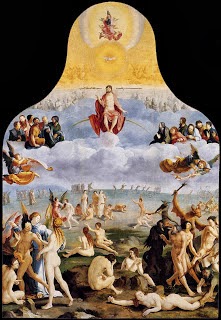
“The Last Judgment” by Lucas van Leyden, 1526


Commentary:

Reading 1: Romans 7:18-25a

Commentary on Rom 7:18-25a

St. Paul continues his existential apologia about over-dependence on the letter of the Law: “…persons who do not experience the justifying grace of God, and Christians who revert to dependence on law as the criterion for their relationship with God, will recognize a rift between their reasoned desire for the goodness of the law and their actual performance that is contrary to the law. Unable to free themselves from the slavery of sin and the power of death, they can only be rescued from defeat in the conflict by the power of God's grace working through Jesus Christ.”[4]

CCC: Rom 7 1963; Rom 7:16 1963; Rom 7:22 1995; Rom 7:23 2542
--------------------------------------------------------
Responsorial Psalm: Psalm 119:66, 68, 76, 77, 93, 94

R. (68b) Lord, teach me your statutes.


In ironic counterpoint to St. Paul’s discourse about the need to be dependent upon the spirit rather than the letter of the law (Romans 7:18-25a), this passage from Psalm 119 give thanks for the Law and rejoices in its structure as a saving grace.

--------------------------------------------------------
Gospel: Luke 12:54-59

Commentary on: Lk 12:54-59

The Lord continues his reflection on the end times (the Parousia) and, using the analogy of seeing what weather will come based upon the direction of the wind, he asks if they cannot see the signs of the coming of the Kingdom of God.  Applying the image of an impending court date at which time a judge will pass a sentence, he urges the people to reconcile themselves with the Lord.  Using that urgency generated by the uncertainty of the hour of that call to judgment, he exhorts the crowd to order their lives now and do not delay.

--------------------------------------------------------
Reflection:

St. Paul sets the tone for us today.  In his Letter to the Romans he gets into a very deep apologia about how the Law of Moses actually defines right and wrong, and therefore opens the door to sin by so defining it.  Those who study Aristotelian syllogistic logic and modern symbolic logic would have loved that argument postulated in classical Greek forms.

For us, however, we look at a much more practical application of that same kind of logic.  As Christians we are defined by the language and logic of Christ.  The concepts he taught go against modern norms surrounding some important concepts.  Let’s take the Lord’s definition of leadership for example.  In his day, political leaders ruled with an iron fist.  There was no democracy, no benevolent governance.  There were rules and armies to enforce those rules, and the leaders lived in lavish comfort, usually having attained their posts through ruthless dealings with their competitors.

Christ taught his disciples to lead through service, telling them that the greatest among them would be the servant of the rest.  This is a complete inversion of the view of leadership in his day (and to a large degree, ours).

Let’s also look at how the Lord defines victory or success.  It is not as the world counts success.  His victory was the baptism of his passion.  It is his great suffering, sacrifice, and ultimate crucifixion that marked his victory.  By the standards of his day (and ours) that would have seemed a defeat, but in dying he destroyed death for those who love him, and fulfilled the plan God had set in motion from the beginning of time.

St. Paul drives a good argument as he twists the logic of his opponents.  As he so eloquently points out: “Thanks be to God through Jesus Christ our Lord.”  In Jesus we have found the hope and reality of salvation through the forgiveness of our sins and new life in his resurrection.

Pax


[1] The picture is “The Last Judgment” by Lucas van Leyden, 1526

[4] See NAB footnote on Romans 7:18ff