Sunday, December 29, 2019

The Sixth Day in the Octave of Christmas


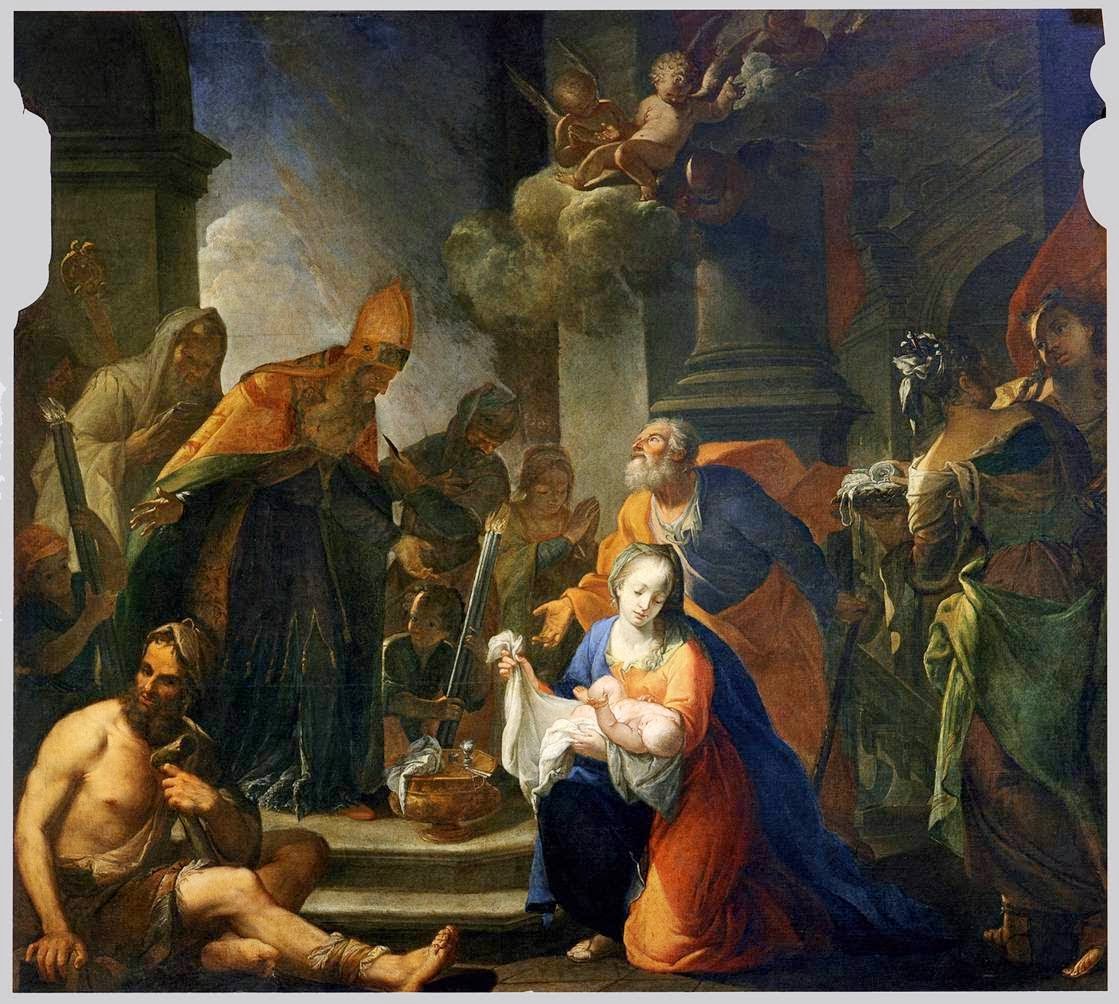
“Presentation of Jesus at the Temple” by Andrea Celesti, c. 1710


Readings and Commentary: [3]

Reading 1: 1 John 2:12-17

I am writing to you, children,
because your sins have been forgiven for his name’s sake.

I am writing to you, fathers,
because you know him who is from the beginning.

I am writing to you, young men,
because you have conquered the Evil One.

I write to you, children,
because you know the Father.

I write to you, fathers,
because you know him who is from the beginning.

I write to you, young men,
because you are strong and the word of God remains in you,
and you have conquered the Evil One.

Do not love the world or the things of the world.
If anyone loves the world, the love of the Father is not in him.
For all that is in the world,
sensual lust, enticement for the eyes, and a pretentious life,
is not from the Father but is from the world.
Yet the world and its enticement are passing away.
But whoever does the will of God remains forever.
-------------------------------------------
Commentary on 1 Jn 2:12-17

St. John addresses his audience individually on sin and forgiveness using an interesting metaphor for the Trinity: children, fathers, young men. The believing community he addresses is armed through faith against the evil one. He focuses in his last paragraph on avoiding the secular world. He exhorts them to separate themselves from “things” of the world, saying that they are of the world and therefore unworthy of special care; they lead the faithful away from God (see also John 17:9-26 and John 15:18-27).

CCC: 1 Jn 2:16 377, 2514, 2534
-------------------------------------------
Responsorial Psalm: Psalm 96:7-8a, 8b-9, 10

R. (11a) Let the heavens be glad and the earth rejoice!

Give to the LORD, you families of nations,
give to the LORD glory and praise;
give to the LORD the glory due his name!
R. Let the heavens be glad and the earth rejoice!

Bring gifts, and enter his courts;
worship the LORD in holy attire.
Tremble before him, all the earth.
R. Let the heavens be glad and the earth rejoice!

Say among the nations: The LORD is king.
He has made the world firm, not to be moved;
he governs the peoples with equity.
R. Let the heavens be glad and the earth rejoice!
-------------------------------------------
Commentary on Ps 96:7-8a, 8b-9, 10

While Psalm 96 is a song of praise, the psalmist reminds us that even in praise we need to offer what we have in gratitude. The structure is familiar: first we are given the audience ("you families of nations"), then the response ("bring gifts, and enter his courts"), and finally praise of God as a response ("he governs the peoples with equity").

-------------------------------------------
Gospel: Luke 2:36-40

There was a prophetess, Anna,
the daughter of Phanuel, of the tribe of Asher.
She was advanced in years,
having lived seven years with her husband after her marriage,
and then as a widow until she was eighty-four.
She never left the temple,
but worshiped night and day with fasting and prayer.
And coming forward at that very time,
she gave thanks to God and spoke about the child
to all who were awaiting the redemption of Jerusalem.

When they had fulfilled all the prescriptions
of the law of the Lord,
they returned to Galilee,
to their own town of Nazareth.
The child grew and became strong, filled with wisdom;
and the favor of God was upon him.
-------------------------------------------
Commentary on Lk 2:36-40

Continuing the story surrounding the presentation of Jesus, in this passage St. Luke describes the prophetess Anna. This role, for widows to prophesy in the temple, was not uncommon. The symbolism depicting Anna has clear linkage back to Old Testament events. It begins with the number seven. Rabbinical literature recognizes seven as the number of prophetesses: Sarah and Miriam in Exodus 15:20, Deborah in  Judges 4:4, Hannah mother of Samuel in 1 Samuel 2:1, Abigail wife of David in 1 Samuel 25:32, Huldah in 2 Kings 22:14, and Esther. These women gave witness to God’s will, at least in their holiness, and spoke in his name. Anna, in this prophetic role (Phanuel translates as “face of God” and Asher as “good luck”), echoes the words of Simeon saying that this young baby (Jesus) is the redemption of Jerusalem. The city, in this instance, represents all of the elect.

The final verses provide a glimpse of Jesus’ necessary hidden life in Nazareth. He grows in faith and stature in preparation for the mission assigned to him.

CCC: Lk 2:38 711
-------------------------------------------
Reflection:

The timing of the first reading from 1 John is very good.  It is almost a week since the great secular glut of commercial Christmas and its aftermath, the post-Christmas feeding frenzy.  Just as we see the children tiring of their new toys and games and the adults thinking about returning to the routines of the world, the evangelist addresses himself to us.  He reminds us first about the meaning of the Nativity whose octave we are still in: “your sins have been forgiven for his name’s sake.”  He then goes on to restate the great Christian paradox found in his own Gospel, to be part of the world but separate from it. 

The Evangelist warns us about what we just went through: “sensual lust, enticement for the eyes, and a pretentious life,” all part of the commercial Christmas.  It is so pervasive that in the U.S., even religious people of non-Christian denominations gather and buy gifts with no attachment whatsoever to the birth of the Savior.

These are not the things of God but, as St. John says, things of the world.  The Christian must be in the world but stand apart from it.  What is truly important is not how well we did “under the tree,” but how well we did by the standards of him who loves us. The Lord came as not just a symbol of love, but love itself, into the world.  Even as we think about taking extra good care of the new golf clubs or the new appliance, we should ask ourselves what we are doing to take care of what is really important in ourselves.

Today we are reminded of our Christian duty and the role we are called to play in God’s plan.  He casts us into the world like seeds so that we might transform it (not be transformed by it).  Today our voices join with the Prophetess Anna in thanking God for the gift of the Christ Child, and pledging to rededicate ourselves to the cause which brought him into the world.

Pax


[1] The picture is “Presentation of Jesus at the Temple” by Andrea Celesti, c. 1710.
[3] The readings are taken from the New American Bible, with the exception of the psalm and its response which were developed by the International Committee for English in Liturgy (ICEL). This republication is not authorized by USCCB and is for private use only.

Saturday, December 28, 2019

Feast of the Holy Family of Jesus, Mary and Joseph


CCC 531-534: the Holy Family
CCC 1655-1658, 2204-2206: the Christian family, a domestic Church
CCC 2214-2233: duties of family members
CCC 333, 530: the Flight into Egypt

“The Holy Family” by Claudio Coello, c. 1685


Readings and Commentary:[4]

Reading 1: Sirach 3:2-6, 12-14

God sets a father in honor over his children;
a mother’s authority he confirms over her sons.
Whoever honors his father atones for sins,
and preserves himself from them.
When he prays, he is heard;
he stores up riches who reveres his mother.
Whoever honors his father is gladdened by children,
and, when he prays, is heard.
Whoever reveres his father will live a long life;
he who obeys his father brings comfort to his mother.

My son, take care of your father when he is old;
grieve him not as long as he lives.
Even if his mind fail, be considerate of him;
revile him not all the days of his life;
kindness to a father will not be forgotten,
firmly planted against the debt of your sins
—a house raised in justice to you.
-------------------------------------------
Commentary on Sir 3:2-6, 12-14

"Throughout the book each doctrinal passage is followed by a section to do with practical applications, sapiential [wisdom] thoughts on moral conduct, eulogies of virtues and sapiential advice on where to seek things that are truly good, etc. This is the first such section. In it the reader will find an exhortation to prudence in all its various forms." [5]

This selection from Sirach is an exposition of the commandment to honor your father and mother. It goes into greater length about the positive benefits that come to the person who does so. It is also consistent with the early Hebrew belief that the honor received by the father of a household was transferred to the children (just as in the omitted verses 8-11, the sins are also transmitted to the children).

CCC: Sir 3:2-6 2218; Sir 3:12 2218
-------------------------------------------

Brothers and sisters:
Put on, as God’s chosen ones, holy and beloved,
heartfelt compassion, kindness, humility, gentleness, and patience,
bearing with one another and forgiving one another,
if one has a grievance against another;
as the Lord has forgiven you, so must you also do.
And over all these put on love,
that is, the bond of perfection.
And let the peace of Christ control your hearts,
the peace into which you were also called in one body.
And be thankful.
Let the word of Christ dwell in you richly,
as in all wisdom you teach and admonish one another,
singing psalms, hymns, and spiritual songs
with gratitude in your hearts to God.
And whatever you do, in word or in deed,
do everything in the name of the Lord Jesus,
giving thanks to God the Father through him. 

Wives, be subordinate to your husbands,
as is proper in the Lord.
Husbands, love your wives,
and avoid any bitterness toward them.
Children, obey your parents in everything,
for this is pleasing to the Lord.
Fathers, do not provoke your children,
so they may not become discouraged.
-------------------------------------------
Commentary on Col 3:12-21

St. Paul exhorts the Colossians with a litany of positive attitudes that culminate in the cardinal axiom of the faith: “love one another.”  He goes on to implore them to let the peace of Christ control their every action and to praise God constantly through Jesus, God’s only Son.

The passage describes the rather controversial family hierarchy of the era portrayed by St. Paul. This entire section of the letter is a discourse on harmony within the family of Christ. It is important to note the instruction given in the first part of this reading. Paul describes the Christian rules for relationships: “Put on, as God’s chosen ones, holy and beloved, heartfelt compassion, kindness, humility, gentleness, and patience, bearing with one another and forgiving one another.”

When the subordinated relationships are described in the verses following, equality in membership in the family is established.

CCC: Col 3:14 815, 1827, 1844; Col 3:16-17 1156, 2633; Col 3:16 2641; Col 3:18-21 2204; Col 3:20 2217; Col 3:21 2286
-------------------------------------------

Brothers and sisters:
Put on, as God’s chosen ones, holy and beloved,
heartfelt compassion, kindness, humility, gentleness, and patience,
bearing with one another and forgiving one another,
if one has a grievance against another;
as the Lord has forgiven you, so must you also do.
And over all these put on love,
that is, the bond of perfection.
And let the peace of Christ control your hearts,
the peace into which you were also called in one body.
And be thankful.
Let the word of Christ dwell in you richly,
as in all wisdom you teach and admonish one another,
singing psalms, hymns, and spiritual songs
with gratitude in your hearts to God.
And whatever you do, in word or in deed,
do everything in the name of the Lord Jesus,
giving thanks to God the Father through him.  
-------------------------------------------
Commentary on Col 3:12-17

This shorter option omits the hierarchical relationship descriptions. Its focus remains consistent, however, driving the Pauline ideals of harmony and unity within the Christian Family.

CCC: Col 3:14 815, 1827, 1844; Col 3:16-17 1156, 2633; Col 3:16 2641
-------------------------------------------
Responsorial Psalm: Psalm 128:1-2, 3, 4-5

R. (cf. 1) Blessed are those who fear the Lord and walk in his ways.

Blessed is everyone who fears the LORD,
   who walks in his ways!
For you shall eat the fruit of your handiwork;
blessed shall you be, and favored.
R. Blessed are those who fear the Lord and walk in his ways.

Your wife shall be like a fruitful vine
   in the recesses of your home;
your children like olive plants
   around your table.
R. Blessed are those who fear the Lord and walk in his ways.

Behold, thus is the man blessed
   who fears the LORD.
The LORD bless you from Zion:
   may you see the prosperity of Jerusalem
   all the days of your life.
R. Blessed are those who fear the Lord and walk in his ways.
-------------------------------------------
Commentary on Ps 128:1-2, 3, 4-5

Psalm 128 is a song of thanksgiving. It begins here with the typical blessings given to those following and having faith in the Lord. This selection uses the analogy of the family and the blessing it brings to the faithful, using the symbolism of vines and olives, imagery commonly used in sacred scripture.

It also supports the creation of woman and the marriage theme in Genesis 2:18-25. It is the logical extension of the two becoming one flesh and the children flowing from that union.

-------------------------------------------

When the magi had departed, behold,
the angel of the Lord appeared to Joseph in a dream and said,
“Rise, take the child and his mother, flee to Egypt,
and stay there until I tell you.
Herod is going to search for the child to destroy him.”
Joseph rose and took the child and his mother by night
and departed for Egypt.
He stayed there until the death of Herod,
that what the Lord had said through the prophet might be fulfilled,
Out of Egypt I called my son.

When Herod had died, behold,
the angel of the Lord appeared in a dream
to Joseph in Egypt and said,
“Rise, take the child and his mother and go to the land of Israel,
for those who sought the child’s life are dead.”
He rose, took the child and his mother,
and went to the land of Israel.
But when he heard that Archelaus was ruling over Judea
in place of his father Herod,
he was afraid to go back there.
And because he had been warned in a dream,
he departed for the region of Galilee.
He went and dwelt in a town called Nazareth,
so that what had been spoken through the prophets
might be fulfilled,
He shall be called a Nazorean
-------------------------------------------
Commentary on Mt 2:13-15, 19-23

The story of the Holy Family fleeing to Egypt is provided in St. Matthew’s Gospel. Angelic messengers are sent to keep Jesus from harm, and guide St. Joseph, the father of Jesus. (The verses 16-18 which are omitted in this reading tell the story of the slaughter of the Holy Innocents in Bethlehem whose feast we celebrated on December 28.) The actions that follow accomplish the task of saving Jesus from Herod. It is also reminiscent of Moses’ flight from Egypt and subsequent return which triggered the salvation event – the Exodus.

The account also mentions that all that happens is in accordance with what has been prophetically revealed. The first reference, indicating that the Messiah was to be called out of Egypt, is a reference to Hosea 11:1. The second reference is less clear as there is no specific Old Testament biblical reference to Nazareth. It is possibly a confusion with the term “neser.” The Old Testament texts are Isaiah 11:1, where the Davidic king of the future is called "a bud" (neser) that shall blossom from the roots of Jesse, and Judges 13:5, 7 where Samson, the future deliverer of Israel from the Philistines, is called one who shall be consecrated (a nazir) to God.

“What a mystery that God, in order to protect his Son, the uncreated Wisdom, now has to do so through the mediation of men! Have we sufficiently reflected on the fact that, after the Incarnation, the Father and the Spirit relate to the Son in a new way; that is, no longer to the Word as divine only, but also and necessarily to the Word as incarnate Man?” [6]

CCC: Mt 2:13-18 530; Mt 2:13 333; Mt 2:15 530; Mt 2:19 333
-------------------------------------------
Reflection:

We continue to celebrate the early events in the life of Jesus during the Christmas season.  Today the tranquility of the birth of the Lord and the accompanying rejoicing are shattered in a dream.  A messenger from God visits Joseph in his dream. This was the second time St. Joseph received direct guidance in this manner.  The first time was when he was reassured about taking Mary as his wife (Matthew 1:19-21).  This time the message is one of alarm.  He is told that King Herod wishes to kill Joseph’s ward and son, like the Egyptians from the time of Moses (Exodus 1:22).  He was instructed to flee to Egypt until the danger passed.

We can only imagine the alarm this caused Mary, the mother of Jesus.  There can be no doubt, however, that this devout family listened to the Lord’s instructions and immediately left the area.  We also know the threat was real.  Shortly after the Holy Family left Bethlehem, Herod’s troops descended upon the town and killed every male baby two years old and under.  Hosea the prophet had heard the cry of that horrible deed hundreds of years before.  Infants, who had not yet uttered a word, offered their life’s blood for the savior of the world (Hosea 11:1).

Nothing is known of the years Joseph and the Holy Family spent in Egypt while waiting for word from the angel to return.  There are tales in the apocryphal gospels about these early years of Jesus’ life but nothing authoritative.  What we can surmise is that these were years of great peace for Mary, Joseph, and their young son.  Their devotion to God was intense, since only one who listens carefully to God may hear with clarity the call to holiness.  Only one who intensely loves the Father would be chosen to care for the most precious gift ever given.  Only one who walks with God daily would hear the messenger who told them it was safe to return.

We rejoice today with the Holy Family, Joseph, Mary and Jesus, who is the Christ.  We rejoice for their years of peace and love, safe in Egypt.  We thank God for calling them back to Nazareth so the young Jesus would grow to manhood, and fulfill the rest of his prophesied mission to bring us salvation.  Finally we look to the perfect love expressed within the Holy Family and pray that our families may work toward that same unity.

Pax


[1] Catechism links are taken from the Homiletic Directory, published by the Congregation for Divine Worship and the Discipline of the Sacraments, 29 June 2014.
[2] The picture used today is “The Holy Family” by Claudio Coello, c. 1685.
[4] The readings are taken from the New American Bible, with the exception of the psalm and its response which were developed by the International Committee for English in Liturgy (ICEL). This republication is not authorized by USCCB and is for private use only.
[5] The Navarre Bible: “Wisdom Books”, Scepter Publishers, Princeton, NJ, © 2003, p. 399.
[6] Fire of Mercy Heart of the Word Volume I, Erasmo Leiva-Merikakis, Ignatius Press, San Francisco, CA, © 1996 p. 89.