Sunday, October 27, 2024

Feast of Saints Simon and Jude, Apostles

Biographical Information about Sts. Simon and Jude

“Saints Simon and Jude.”
Iconifer and date are unknown

Readings for the Feast of Saints Simon and Jude [1]
 
Readings from the Jerusalem Bible [2]
 
Readings and Commentary: [3]
 
Reading 1: Ephesians 2:19-22
 
Brothers and sisters:
You are no longer strangers and sojourners,
but you are fellow citizens with the holy ones
and members of the household of God,
built upon the foundation of the Apostles and prophets,
with Christ Jesus himself as the capstone.
Through him the whole structure is held together
and grows into a temple sacred in the Lord;
in him you also are being built together
into a dwelling place of God in the Spirit.
-------------------------------------------
Commentary on Eph 2:19-22
 
In this passage, St. Paul describes the unity brought about among all believers in Christ. This unity is formed under a common teaching flowing from the Hebrew prophets, through the apostles, to Christ himself, who is described as the “capstone” or cornerstone. This unity of spirit becomes the Church, the “dwelling place for God in the Spirit.” The Church, in turn, is the unity of all Christians, those who were formerly Jews, and those who were formerly Gentiles. They are, says the apostle, joined through Christ on the same road to the kingdom of God. They share the same foundation of faith, transmitted to them through the apostles, and held firm by Christ the “capstone.” Together they form the “temple of the Spirit,” the essential understanding that the Church is the Mystical Body of Christ.
 
CCC: Eph 2:19-22 756; Eph 2:20 857; Eph 2:21 797
-------------------------------------------
Responsorial Psalm: Psalm 19:2-3, 4-5
 
R. (5a) Their message goes out through all the earth.
 
The heavens declare the glory of God,
and the firmament proclaims his handiwork.
Day pours out the word to day,
and night to night imparts knowledge.
R. Their message goes out through all the earth.
 
Not a word nor a discourse
whose voice is not heard;
Through all the earth their voice resounds,
and to the ends of the world, their message.
R. Their message goes out through all the earth.
-------------------------------------------
Commentary on Ps 19:2-3, 4-5
 
Psalm 19 is a hymn of praise. In these opening strophes, the psalmist rejoices in God’s visible hand, revealed in all creation. It is the first of two themes expressed in the psalm (the other is in praise of the law). While no word of God announces his presence, his glory is revealed in the creation of all things.
 
CCC: Ps 19:2-5 299; Ps 19:2 326
-------------------------------------------
Gospel: Luke 6:12-16
 
Jesus went up to the mountain to pray,
and he spent the night in prayer to God.
 
When day came, he called his disciples to himself,
and from them he chose Twelve, whom he also named Apostles:
Simon, whom he named Peter, and his brother Andrew,
James, John, Philip, Bartholomew, Matthew,
Thomas, James the son of Alphaeus,
Simon who was called a Zealot,
and Judas the son of James,
and Judas Iscariot, who became a traitor.
-------------------------------------------
Commentary on Lk 6:12-16
 
This passage is the call of the twelve apostles from St. Luke’s Gospel. It is noteworthy that Jesus begins this process with a prayer of discernment.  He then names the Twelve (including Judas Iscariot who was replaced after his suicide).  This important event extends Jesus' mission through these chosen ones (selected from the ranks of Jesus’ disciples: see Mark 3:14-15).  This selection marked them with special authority (Matthew 10:1ff) and responsibility to transmit the gospel to the world. The Lord is conscious of establishing the “New Israel.” His selection of the Twelve is symbolic of appointing new leaders of the twelve tribes of the Hebrew people who are rejecting him as Messiah.
 
CCC: Lk 6:12-16 1577; Lk 6:12 2600
-------------------------------------------
Reflection:
 
The celebration of the Feast of Sts. Simon and Jude reminds us our own call to be an apostolic people.  We’ve heard that term used, especially in the Dogmatic Constitution on the Church (Lumen Gentium).  Through Christ’s call in Scripture, and through our own understanding of what we, as a people of God, believe our call to be, we recognize a special responsibility to participate in the same mission for which the twelve apostles were selected.
 
While it is argued that we are all given different gifts and aptitudes by God, and therefore we are not all cut out to go into the world verbalizing God’s call to holiness to each person we meet, we are all called to do our part in this great work.  We believe this is not optional.  We cannot simply say: “I believe in God and that Jesus came as God’s Only Son.  Therefore, because I accept him as my personal Savior (he did not come for just one person), I am saved.”  No, our faith, breathed in through Sacred Scripture, breathed in through the sacraments, breathed in through prayer, must be breathed out in actions, a living witness that testifies to our faith.
 
The apostles were taken aside by Jesus and given a special authority, special gifts that would allow them to take Jesus’ message into the world, so that all might hear the message and live.  He did not restrict this truth to his followers, somehow implying this was a secret or special insight given to them alone! Rather he gave his followers the mission of taking that message to all the corners of the earth. 
 
To Jesus, the world was a giant canvas upon which he painted, using the brushes of the apostles in bold strokes.  But much of what the apostles could do was also passed on.  The blank pieces of canvas were to be filled in by those they touched, and then further by those touched by students of the students of the Twelve, continuing until at last the brush is handed to us, so that every speck can be coated with the love of Christ.
 
Today we celebrate the great work of Saints Simon and Jude, apostles.  In their lives and missions, we see the hand of God reach out to the world, inviting all to come and live.  We see also, in their call, our own invitation to participate in this great apostolic work of the Church in the world.  We pray today for all who work to spread God’s message.  We pray also for ourselves, that we might accept the call to witness the love of Christ in all we do.
 
Pax
 
In other years on this date: 
Monday of the Thirtieth Week in Ordinary Time
 
[1] The picture is The picture is “Saints Simon and Jude.” Iconifer and date are unknown.
[2] S.S. Commemoratio
[3] The readings are taken from the New American Bible, with the exception of the psalm and its response which were developed by the International Committee for English in Liturgy (ICEL). This republication is not authorized by USCCB and is for private use only.

Saturday, October 26, 2024

Thirtieth Sunday in Ordinary Time

Catechism Links [1]

CCC 547-550: Jesus performed messianic signs
CCC 1814-1816: faith, a gift of God
CCC 2734-2737: filial confidence in prayer

“Christ Healing the Blind Man”
by Eustache Le Sueur, c. 1650
 
Readings for Thirtieth Sunday in Ordinary Time [2]
 
Readings from the Jerusalem Bible [3]
 
Readings and Commentary: [4]
 
Reading 1: Jeremiah 31:7-9
 
Thus says the LORD:
Shout with joy for Jacob,
exult at the head of the nations;
proclaim your praise and say:
The LORD has delivered his people,
the remnant of Israel.
Behold, I will bring them back
from the land of the north;
I will gather them from the ends of the world,
with the blind and the lame in their midst,
the mothers and those with child;
they shall return as an immense throng.
They departed in tears,
but I will console them and guide them;
I will lead them to brooks of water,
on a level road, so that none shall stumble.
For I am a father to Israel,
Ephraim is my first-born.
-------------------------------------------
Commentary on Jer 31:7-9
 
The prophet Jeremiah is looking forward to the return of the Hebrews from their exile. In this selection he foresees the return of a great throng, gathered from the far reaches of the world as the people return to the Promised Land – Jerusalem. The prophet speaks to the people of the salvation that will be theirs because God has chosen them for his own. The passage serves as a prelude to Jeremiah’s great song beginning in the next verse.
 
CCC: Jer 31 1611
-------------------------------------------
Responsorial Psalm: Psalm 126:1-2, 2-3, 4-5, 6
 
R. (3) The Lord has done great things for us; we are filled with joy.
 
When the LORD brought back the captives of Zion,
we were like men dreaming.
Then our mouth was filled with laughter,
and our tongue with rejoicing.
R. The Lord has done great things for us; we are filled with joy.
 
Then they said among the nations,
"The LORD has done great things for them."
The LORD has done great things for us;
we are glad indeed.
R. The Lord has done great things for us; we are filled with joy.
 
Restore our fortunes, O LORD,
like the torrents in the southern desert.
Those that sow in tears
shall reap rejoicing.
R. The Lord has done great things for us; we are filled with joy.
 
 Although they go forth weeping,
carrying the seed to be sown,
They shall come back rejoicing,
carrying their sheaves.
R. The Lord has done great things for us; we are filled with joy.
-------------------------------------------
Commentary on Ps 126:1-2, 2-3, 4-5, 6
 
Psalm 126 is a lament. In this short psalm, the singer rejoices at the return of Israel following the Diaspora, the conquering of Israel and its enslavement. In this hymn, the people remember the greatness of God as he restores their nation and brings them back to their own land ("Although they go forth weeping, carrying the seed to be sown, they shall come back rejoicing, carrying their sheaves"). The sense is one of being overflowing with thanksgiving.
 
-------------------------------------------
Reading II: Hebrews 5:1-6  
 
Brothers and sisters:
Every high priest is taken from among men
and made their representative before God,
to offer gifts and sacrifices for sins.
He is able to deal patiently with the ignorant and erring,
for he himself is beset by weakness
and so, for this reason, must make sin offerings for himself
as well as for the people.
No one takes this honor upon himself
but only when called by God,
just as Aaron was.
In the same way,
it was not Christ who glorified himself in becoming high priest,
but rather the one who said to him:
You are my son:
this day I have begotten you;
just as he says in another place:
You are a priest forever
according to the order of Melchizedek.
-------------------------------------------
Commentary on Heb 5:1-6
 
This is an important passage from the standpoint of understanding the call to ministry, especially the priesthood. It is frequently used at ordinations and provides an understanding of what it means to be called to a vocation: “No one takes this honor upon himself but only when called by God.”
 
The author concludes with a reference to the “order of Melchizedek,” the priest king, first identified in Genesis 14:18 and referenced again in Psalm 110:4. The image of Melchizedek is used to prefigure Christ, the Messiah, who is priest, prophet and king. This same indelible character is imposed upon those called to God’s service in the priesthood.
 
CCC: Heb 5:1 1539; Heb 5:3 1540; Heb 5:4 1578; Heb 5:6 1537
-------------------------------------------
Gospel: Mark 10:46-52
 
As Jesus was leaving Jericho with his disciples and a sizable crowd,
Bartimaeus, a blind man, the son of Timaeus,
sat by the roadside begging.
On hearing that it was Jesus of Nazareth,
he began to cry out and say,
"Jesus, son of David, have pity on me."
And many rebuked him, telling him to be silent.
But he kept calling out all the more,
"Son of David, have pity on me."
Jesus stopped and said, "Call him."
So they called the blind man, saying to him,
"Take courage; get up, Jesus is calling you."
He threw aside his cloak, sprang up, and came to Jesus.
Jesus said to him in reply, "What do you want me to do for you?"
The blind man replied to him, "Master, I want to see."
Jesus told him, "Go your way; your faith has saved you."
Immediately he received his sight
and followed him on the way.
-------------------------------------------
Commentary on Mk 10:46-52
 
In St. Mark’s story of the cure of the blind man (see also Matthew 20:29-34 and Luke 18:35-43), it is the way he addresses Jesus that becomes the focus. We are told he address him as “Son of David.” This is the messianic title applied by Jewish tradition to the one who comes to “heal the blind and the lame and set the prisoners free” (Isaiah 42;6-7). In response to the blind man’s request, “Master, I want to see,” in an almost casual way, Jesus tells him his faith has saved him and the blind man sees. Not surprisingly the now sighted man follows Jesus.
 
CCC: Mk 10:46-52 2667; Mk 10:48 2616; Mk 10:52 548
-------------------------------------------
Reflection:
 
Students who will be assisting the blind are frequently required to spend an extended period (perhaps a couple of days) blindfolded, completely without sight or light, to help them understand what it feels like for their future charges. There are few things in life we would miss more than our ability to see. While those physically without sight have learned to compensate for their lack of sight with other senses and aids, those of us who see today would be in a pretty sorry state if tomorrow we woke up and the world was dark.
 
Most are probably thinking, “Yes, I know Jesus did the blind man a huge service by restoring his sight.” And of course, you would be right. But let us look at this action metaphorically for a moment. Let us assume that it is not physical sight that was restored but the light of truth that was given. Perhaps what the blind man received was not just the ability to perceive the world around him, but the ability to understand what God wanted for him. Just as a sighted person can see danger and avoid it, so the enlightened person can see spiritual danger and avoid it. Recall, St. Peter even mentioned this in his letter; “keep away from worldly desires that wage war against the soul” (1 Peter 2:11). The ability to see and avoid these dangers comes from our spiritual sight, sight only the Lord can give
 
A very important element of this entire saga lies in the concluding words of the Scripture passage from St. Mark’s Gospel. "Go your way; your faith has saved you." This is the heart of the Lord’s message of salvation.  We are called to draw on the strength of faith, freely given, in all we do, and doing so the Lord, through the Holy Spirit, gives us his love through which all things are possible.
 
The very good news is that he offers this gift to us freely. It is enhanced through sacramental grace, like corrective lenses or laser eye surgery. We see more clearly as a result of the special grace given in the sacraments. Today as we recall how Jesus gave sight to the blind, we pray that he will continue to shed his light on our path so that we might not stumble as we walk with him.
 
Pax

[1] Catechism links are taken from the Homiletic Directory, published by the Congregation for Divine Worship and the Discipline of the Sacraments, 29 June 2014.
[2] The picture today is “Christ Healing the Blind Man” by Eustache Le Sueur, c. 1650.
[3] S.S. Commemoratio
[4] The readings are taken from the New American Bible, with the exception of the psalm and its response which were developed by the International Committee for English in Liturgy (ICEL). This republication is not authorized by USCCB and is for private use only.

Friday, October 25, 2024

Saturday of the Twenty-ninth Week in Ordinary Time

Optional Memorial of the Blessed Virgin Mary
 
On Saturdays in Ordinary Time when there is no obligatory memorial, an optional memorial of the Blessed Virgin Mary is allowed. [1] Mass texts may be taken from the Common of the Blessed Virgin Mary, from a Votive Mass, or from the special collection of Masses for the Blessed Virgin Mary. Suggested for this date: #39B. Holy Mary, Queen and Mother of Mercy.

“The Redeemer”
by Master of the Osservanza, c. 1450
 
Readings for Saturday of the Twenty-ninth Week in Ordinary Time [2]
 
Readings from the Jerusalem Bible [3]
 
Readings and Commentary: [4]
 
Reading 1: Ephesians 4:7-16
 
Brothers and sisters:
Grace was given to each of us
according to the measure of Christ’s gift.
Therefore, it says:
 
He ascended on high and took prisoners captive;
he gave gifts to men.
 
What does “he ascended” mean except that he also descended
into the lower regions of the earth?
The one who descended is also the one who ascended
far above all the heavens,
that he might fill all things.
 
And he gave some as Apostles, others as prophets,
others as evangelists, others as pastors and teachers,
to equip the holy ones for the work of ministry,
for building up the Body of Christ,
until we all attain to the unity of faith
and knowledge of the Son of God, to mature manhood
to the extent of the full stature of Christ,
so that we may no longer be infants,
tossed by waves and swept along by every wind of teaching
arising from human trickery,
from their cunning in the interests of deceitful scheming.
Rather, living the truth in love,
we should grow in every way into him who is the head, Christ,
from whom the whole Body,
joined and held together by every supporting ligament,
with the proper functioning of each part,
brings about the Body’s growth and builds itself up in love.
-------------------------------------------
Commentary on Eph 4:7-16
 
St. Paul continues his plea for unity in this passage. He defines unity as more than just sharing a belief in Christ through his analogy and example. Unity is exemplified by the gifts (and grace) given by Christ. The apostle uses a quote from an older form of Psalm 68:18-19.  (The psalm itself depicts Yahweh leading Israel to salvation, while St. Paul sees in this image Jesus' entry into the New Jerusalem.) The apostle uses this quote to describe how Jesus (metaphorically capturing the spirits of the faithful) brought gifts to each person. The reference, “he also descended,” likely refers to Christ’s incarnation rather than to his descent following his crucifixion.
 
St. Paul continues his discourse, enumerating the leadership gifts given to “building up the Body of Christ,” bringing the fledgling Church to maturity. In maturity, the apostle tells the Ephesians, they will resist those who teach falsely and become more unified in the love they share.
 
CCC: Eph 4:7 913; Eph 4:8-10 661; Eph 4:9-10 611, 2795; Eph 4:9 633, 635; Eph 4:10 668; Eph 4:11-16 794; Eph 4:11-13 669; Eph 4:11 1575; Eph 4:13 674, 695, 2045; Eph 4:16 798
-------------------------------------------
Responsorial Psalm: Psalm 122:1-2, 3-4ab, 4cd-5
 
R. (1) Let us go rejoicing to the house of the Lord.
 
I rejoiced because they said to me,
“We will go up to the house of the LORD.”
And now we have set foot
within your gates, O Jerusalem.
R. Let us go rejoicing to the house of the Lord.
 
Jerusalem, built as a city
with compact unity.
To it the tribes go up,
the tribes of the LORD.
R. Let us go rejoicing to the house of the Lord.
 
According to the decree for Israel,
to give thanks to the name of the LORD.
In it are set up judgment seats,
seats for the house of David.
R. Let us go rejoicing to the house of the Lord.
-------------------------------------------
Commentary on Ps 122:1-2, 3-4ab, 4cd-5
 
Psalm 122 is a song of thanksgiving centered upon returning to the temple in Jerusalem. (Mosaic Law required such a trip three times in an individual's life.) The song rejoices in the visit to the holy place, the seat of King David. The original singers would have been rejoicing at returning to the one temple. For Christians, the new Jerusalem is the one and only house of God in his heavenly kingdom. There the Lord sits in judgment. In these strophes the image of “going up to Jerusalem” echoes the Lord’s return in St. Paul’s quote of Psalm 68:18-19 in Ephesians 4:8.
 
-------------------------------------------
Gospel: Luke 13:1-9
 
Some people told Jesus about the Galileans
whose blood Pilate had mingled with the blood of their sacrifices.
He said to them in reply,
“Do you think that because these Galileans suffered in this way
they were greater sinners than all other Galileans?
By no means!
But I tell you, if you do not repent,
you will all perish as they did!
Or those eighteen people who were killed
when the tower at Siloam fell on them–
do you think they were more guilty
than everyone else who lived in Jerusalem?
By no means!
But I tell you, if you do not repent,
you will all perish as they did!”
 
And he told them this parable:
“There once was a person who had a fig tree planted in his orchard,
and when he came in search of fruit on it but found none,
he said to the gardener,
‘For three years now I have come in search of fruit on this fig tree
but have found none.
So cut it down.
Why should it exhaust the soil?’
 
He said to him in reply,
‘Sir, leave it for this year also,
and I shall cultivate the ground around it and fertilize it;
it may bear fruit in the future.
If not you can cut it down.’”
-------------------------------------------
Commentary on Lk 13:1-9
 
In the story from St. Luke, there is once more a reminder that urgency is required in seeking repentance.  The story begins with an explanation by the Lord that victims of Roman punishment ("whose blood Pilate had mingled with the blood of their sacrifices"), and victims of an accident ("those eighteen people who were killed when the tower at Siloam fell on them"), were not singled out  by God for punishment. These statements are followed by the parable of the barren fig tree as a way of saying that God, at some point, will become impatient, and will call sinners to account for their actions.
 
The incidents recorded at the beginning of this reading (likely the accidental death of those on whom the tower fell) are found only in St. Luke’s Gospel. Based upon historical works of the time, the actions of Pilate were in keeping with his character. Jesus uses the event to call his audience to repentance.
 
“Following on the call to repentance, the parable of the barren fig tree presents a story about the continuing patience of God with those who have not yet given evidence of their repentance (see Luke 3:8). The parable may also be alluding to the delay of the end time, when punishment will be meted out, and the importance of preparing for the end of the age because the delay will not be permanent.” [5]
 
-------------------------------------------
Reflection:
 
Scripture today, especially from the Gospel, points to one very important lesson for the faithful.  The Lord is being told by a member of one of the crowds that frequently gathered about two situations in which unexpected death had occurred.  First, Pilate (yes, that Pilate) had apparently slaughtered a group of people, probably at the temple since the Gospel relates that: “whose blood Pilate had mingled with the blood of their sacrifices.”
 
The Gospel goes on to talk about eighteen people who were killed in Jerusalem when one of the towers that guarded the aqueduct that fed the pool of Siloam collapsed on them.  Scholars believe this may have been an act of zealot sabotage.
 
In both these cases, the Lord does not condemn the person, in the case of Pilate, or persons in the second instance.  Rather, he points to the need for repentance, implying what he later said plainly: we do not know the hour or day when we will be called home to the Father.
 
In the second part of the Gospel, Jesus gives us the parable of the fig tree.  He tells the story of a landowner who was waiting for one of his trees to bear fruit and, after three years, when it did not, the owner told his gardener to cut it down.  Since all it was doing was depleting the soil of his garden it was of no value.  The gardener asked for patience and offered to ”cultivate the ground around it and fertilize It,” if the landowner would be patient a while longer.
 
This story is very good news for us.  It tells us that the Lord, while he expects us to bear fruit through our prayers, words, and actions, is willing to be patient.  The urgency of that call to repentance is amplified by the parable.  Jesus comes as the gardener to nourish us and intercede for us so that we might bear fruit, but we must turn away from sin to do so.
 
The story also tells us we have free will.  We can choose salvation through repentance.  Even though we may have fallen far from Christ, the great gardener continues to till soil, that we may bear fruit.
 
As we continue our journey of faith looking for ways to more effectively answer God’s call to us (a burning bush would be nice), we recognize that we must repent.  We must repent not just in our heart and prayers, but those thoughts and prayers must be expressed in actions, what we do, and how we treat others.  We need to be constantly striving to live the example Jesus gave us, because we do not know the day or the hour.
 
Pax

[1] General Norms for the Liturgical Year and the Calendar Miscellaneous Notes no. 5: “Outside Advent, Christmas Time, Lent, and Easter Time, on Saturdays which have no commemoration having the rank of Obligatory Memorial or higher, a Mass in honor of the Blessed Virgin Mary may be celebrated. This is indicated in the calendar by ‘BVM.’ The readings and prayers may be selected from the Collection of Masses of the Blessed Virgin Mary.”
[2] The picture used today is “The Redeemer” by Master of the Osservanza, c. 1450.
[3] S.S. Commemoratio
[4] The readings are taken from the New American Bible, with the exception of the psalm and its response which were developed by the International Committee for English in Liturgy (ICEL). This republication is not authorized by USCCB and is for private use only.
[5] NAB footnote on Luke 13:6-9.
 

Thursday, October 24, 2024

Friday of the Twenty-ninth Week in Ordinary Time

“The Last Judgment”
Frans Francken II, 1606
 
Readings for Friday of the Twenty-ninth Week in Ordinary Time [1]
 
Readings from the Jerusalem Bible [2]
 
Readings and Commentary: [3]
 
Reading 1: Ephesians 4:1-6
 
Brothers and sisters:
I, a prisoner for the Lord,
urge you to live in a manner worthy of the call you have received,
with all humility and gentleness, with patience,
bearing with one another through love,
striving to preserve the unity of the spirit
through the bond of peace;
one Body and one Spirit,
as you were also called to the one hope of your call;
one Lord, one faith, one baptism;
one God and Father of all,
who is over all and through all and in all.
-------------------------------------------
Commentary on Eph 4:1-6
 
St. Paul begins this chapter of his letter to the Ephesians with an exhortation to live (walk) in unity with each other. The theological foundation (the "mystery" of Christ - the calling of all men, Gentiles and Jews, to form a single people, the Church) laid down in the previous parts of the letter is now translated into the need to act upon that reality. The apostle's plea for unity uses the litany of bonds that bring Christian unity: one body, one Spirit, one hope, one Lord, one baptism, and one God and Father.
 
"To show the importance of unity in the Church, and the theological basis of that unity, St Paul quotes an acclamation which may well have been taken from early Christian baptismal liturgy. It implies that the unity of the Church derives from the unicity of the divine essence. The text also reflects the three persons of the Blessed Trinity who are at work in the Church and who keep it together – one Spirit, one Lord, one God and Father." [4]
 
CCC: Eph 4-6 1454; Eph 4-5 1971; Eph 4:2 2219; Eph 4:3-5 866; Eph 4:3 814; Eph 4:4-6 172, 249, 2790
-------------------------------------------
Responsorial Psalm: Psalm 24:1bc-2, 3-4ab, 5-6
 
R. (see 6) Lord, this is the people that longs to see your face.
 
The earth is the LORD'S and all it holds,
the world and those who live there.
For God founded it on the seas,
established it over the rivers.
R. Lord, this is the people that longs to see your face.
 
Who may go up the mountain of the LORD?
Who can stand in his holy place?
"The clean of hand and pure of heart,
who are not devoted to idols,
R. Lord, this is the people that longs to see your face.
 
They will receive blessings from the LORD,
and justice from their saving God.
Such are the people that love the LORD,
that seek the face of the God of Jacob." Selah
R. Lord, this is the people that longs to see your face.
-------------------------------------------
Commentary on Ps 24:1bc-2, 3-4ab, 5-6
 
Psalm 24 is a processional song. It recalls that God is the great creator, and he calls his people to be faithful. It is part of a hymn of entrance, sung as the Ark of the Covenant was brought into the temple, followed by the faithful. The song asks the question: who can come into his presence, and answers: only those who are sinless (completely reconciled to God). Those who achieve that beatified state will receive the reward of eternal life from the savior.
 
The hymn focuses on the character of the one who worthily seeks God, and the one who is worthy to come into God’s kingdom and stand before him. This same concept is borrowed in a passage from John’s Revelation (Revelation 14:4ff): who are the ones allowed full access to God? They are those: “whose hands are sinless, whose heart is clean, who desires not what is vain.” In other words, they are clean in heart, body, and spirit.
 
CCC: Ps 24:6 2582
-------------------------------------------
Gospel: Luke 12:54-59
 
Jesus said to the crowds,
“When you see a cloud rising in the west
you say immediately that it is going to rain–and so it does;
and when you notice that the wind is blowing from the south
you say that it is going to be hot–and so it is.
You hypocrites!
You know how to interpret the appearance of the earth and the sky;
why do you not know how to interpret the present time?
 
“Why do you not judge for yourselves what is right?
If you are to go with your opponent before a magistrate,
make an effort to settle the matter on the way;
otherwise your opponent will turn you over to the judge,
and the judge hand you over to the constable,
and the constable throw you into prison.
I say to you, you will not be released
until you have paid the last penny.”
-------------------------------------------
Commentary on Lk 12:54-59
 
The Lord continues his reflection on the end times (the Parousia), and using the analogy of seeing what weather will come based upon the direction of the wind, he asks the people if they cannot see the signs of the coming of the kingdom of God. Applying the image of an impending court date, at which time a judge will pass a sentence, he urges the people to reconcile themselves with the Lord. Using the urgency generated by the uncertainty of the hour of that call to judgment, he exhorts the crowd to order their lives now, and do not delay.
 
"The point is made more generally: when it comes to earth and sky (the two divisions of the natural order), people bring to bear their interpretive skills to anticipate the future and so to be prepared for it. Jesus accuses the crowds of hypocrisy because they are not ready to apply the same shrewdness to the indicators contained in the unfolding of his own ministry (and perhaps also its precursor in the ministry of John). The events of “this [present] time” point just as reliably as any weather indicators to the coming day of answerability to God." [5]
 
-------------------------------------------
Reflection:
 
In St. Luke’s Gospel, Jesus continues his discourse about the inevitability of the end times.  He has already said that we must be prepared because we do not know when that will happen.  In this final part of his discourse, Jesus, now speaking once more to the crowd that had gathered, uses the analogy of a person going into litigation over a debt to emphasize the need to avoid procrastination.
 
The language used conveys an urgency that must have infected St. Paul later on as he fully expected this event to take place in his own lifetime.  He never realized that Jesus was speaking in terms of each person’s journey that would end before the judgment seat of Christ, rather than of some terrible cataclysm, ending all life everywhere.  When Jesus was crucified (“a baptism with which I must be baptized” Luke 12: 50), the end that was a beginning started.  We are not denying that, as Scripture in other places foretells, there will be a second coming, a new resurrection.  Rather we know that we face our own end, and our life on this earth has its own conclusion for which we must be prepared.
 
Jesus sees this finite strand of life to which we cling and sees also that we must seek to conform ourselves to God’s will on this earth to avoid our later regret.  How many stories have we heard about the long line before the pearly gates?  The reality of that line is something else completely.  Who among us would wish to come before the Lord as we are, right at this moment?  Would we be willing to show him all of the sins we have committed, unatoned?  Would we rather not hope that our assent to stand before that judgment seat might include a period of time when those sins we carried with us might be recognized and expiated by our will, our righteous understanding?  Is this not how we understand purgatory, that process of purification where we may be made worthy to stand before Christ, with his angels and saints?
 
To the Lord’s point though: Knowing that we “will not be released until you have paid the last penny,” we are reminded that we have time, we should not delay.  We all need to examine carefully what we have done, and make sure that those sins are laid out before God, and our contrition demonstrates a conversion of heart.  We can think about this time as our time walking with the Lord, on the way to court.  We pray that we can settle accounts before we reach that destination.
 
Pax

[1] The picture is “The Last Judgment” Frans Francken II, 1606.
[2] S.S. Commemoratio
[3] The readings are taken from the New American Bible, with the exception of the psalm and its response which were developed by the International Committee for English in Liturgy (ICEL). This republication is not authorized by USCCB and is for private use only.
[4] Letters of St. Paul, The Navarre Bible, Four Courts Press, 2003, p. 391.
[5] John Nolland, Luke 9:21–18:34, vol. 35B, Word Biblical Commentary (Dallas: Word, Incorporated, 1993), 712–13.

Wednesday, October 23, 2024

Thursday of the Twenty-ninth Week in Ordinary Time

Optional Memorial for Saint Anthony Mary Claret, Bishop 

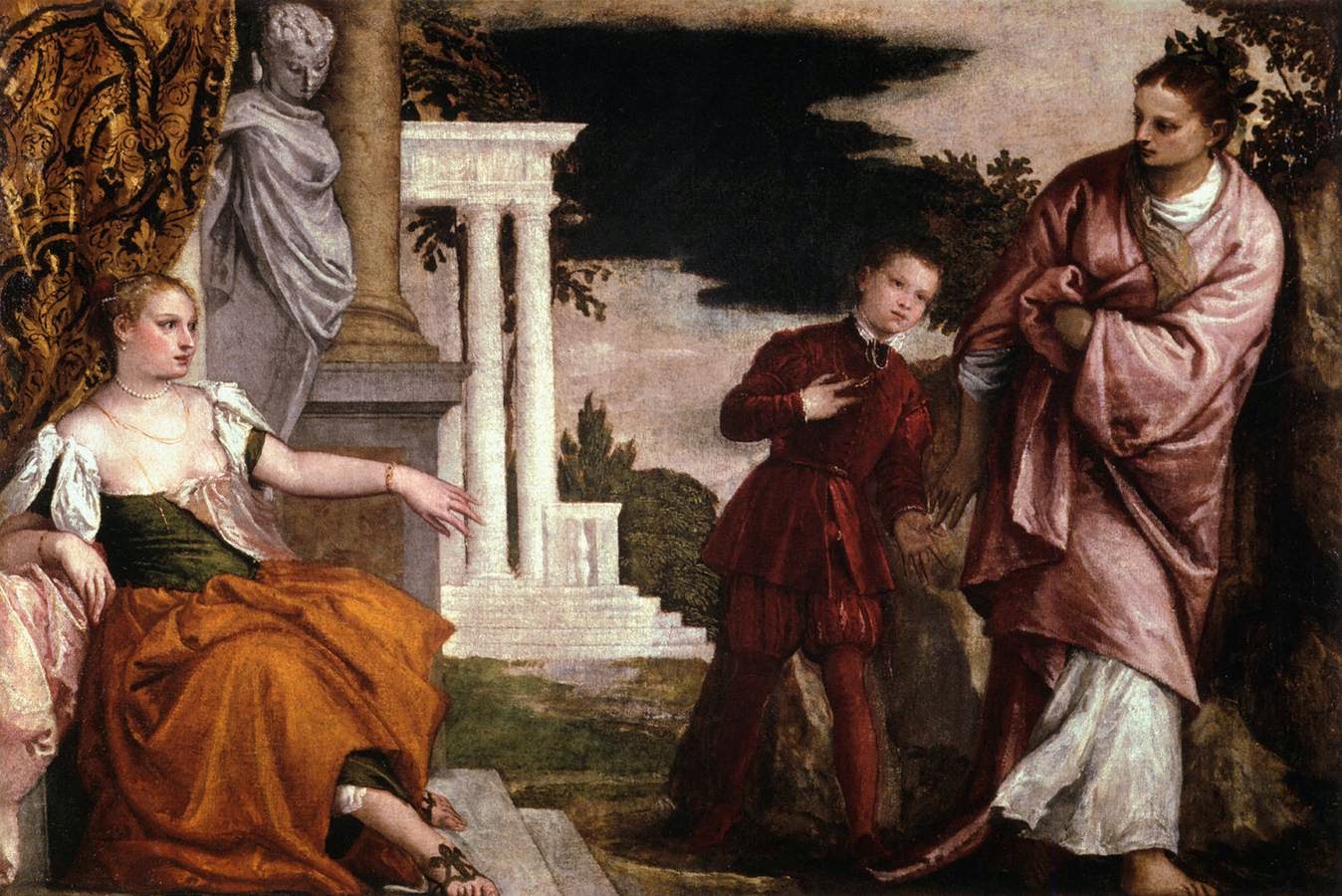
“Youth between Virtue and Vice”
by Paolo Veronese, 1580-82

Readings for Thursday of the Twenty-ninth Week in Ordinary Time [1]
 
Readings from the Jerusalem Bible [2]
 
Readings and Commentary: [3]
 
Reading 1:  Ephesians 3:14-21
 
Brothers and sisters:
I kneel before the Father,
from whom every family in heaven and on earth is named,
that he may grant you in accord with the riches of his glory
to be strengthened with power through his Spirit in the inner self,
and that Christ may dwell in your hearts through faith;
that you, rooted and grounded in love,
may have strength to comprehend with all the holy ones
what is the breadth and length and height and depth,
and to know the love of Christ that surpasses knowledge,
so that you may be filled with all the fullness of God.
 
Now to him who is able to accomplish far more than all we ask or imagine,
by the power at work within us,
to him be glory in the Church and in Christ Jesus
to all generations, forever and ever. Amen..
-------------------------------------------
Commentary on Eph 3:14-21
 
St. Paul has informed the Ephesians of the difficulties (imprisonment) he is facing, but has asked them to stay focused on their own spiritual growth, rather than concern themselves over his “afflictions” (Ephesians 3:1). He offers them the “Apostle’s Prayer." “The apostle prays that those he is addressing may, like the rest of the church, deepen their understanding of God's plan of salvation in Christ. It is a plan that affects the whole universe (Ephesians 3:15) with the breadth and length and height and depth of God's love in Christ (Ephesians 3:18) or possibly the universe in all its dimensions. The apostle prays that they may perceive the redemptive love of Christ for them and be completely immersed in the fullness of God (Ephesians 3:19).” [4]
 
CCC: Eph 3:14 239, 2214, 2367; Eph 3:16-17 1073, 2714; Eph 3:16 1995; Eph 3:18-21 2565; Eph 3:20-21 2641
-------------------------------------------
Responsorial Psalm: Ps 33:1-2, 4-5, 11-12, 18-19
 
R. (5b) The earth is full of the goodness of the Lord.
 
Rejoice, you just, in the LORD;
praise from the upright is fitting.
Give thanks to the LORD on the harp;
on the ten-stringed lyre offer praise.
 R. The earth is full of the goodness of the Lord.
 
For the LORD'S word is true;
all his works are trustworthy.
The LORD loves justice and right
and fills the earth with goodness.
R. The earth is full of the goodness of the Lord.
 
But the plan of the LORD stands forever,
wise designs through all generations.
Happy the nation whose God is the LORD,
the people chosen as his very own.
 R. The earth is full of the goodness of the Lord.
 
But the LORD'S eyes are upon the reverent,
upon those who hope for his gracious help,
Delivering them from death,
keeping them alive in times of famine.
R. The earth is full of the goodness of the Lord.
-------------------------------------------
Commentary on Ps 33:1-2, 4-5, 11-12, 18-19
 
Psalm 33 is a song of praise and thanksgiving. In this selection, the emphasis is on faithfulness to God, who has saving power, combined with hope, a central component of faith in God.  It concludes, almost in answer to St. Paul’s "Apostle’s Prayer," for strength in the face of persecution (Ephesians 3:14-21).
 
-------------------------------------------
Gospel: Luke 12:49-53
 
Jesus said to his disciples:
“I have come to set the earth on fire,
and how I wish it were already blazing!
There is a baptism with which I must be baptized,
and how great is my anguish until it is accomplished!
Do you think that I have come to establish peace on the earth?
No, I tell you, but rather division.
From now on a household of five will be divided,
three against two and two against three;
a father will be divided against his son
and a son against his father,
a mother against her daughter
and a daughter against her mother,
a mother-in-law against her daughter-in-law
and a daughter-in-law against her mother-in-law.”
-------------------------------------------
Commentary on Lk 12:49-53
 
This discourse from St. Luke’s Gospel emphasizes the divisive nature of Christ’s message. He has already encountered resistance, and the author sees that his message of peace will have an even more profound influence on the world. It is clear that the Lord knows many will not be able to accept his words, and this will cause enmity among people, even within families.
 
In this passage, there is a glimpse of the passion (the baptism mentioned in  v.50  shares the image presented in Psalm 124:4-5), and the anguish the Lord feels for the message he is bringing. He sees the flame of faith igniting the whole world. Jesus knows there will be those who accept the proclamation of the kingdom of God, and those who will reject both it and him.
 
CCC: Lk 12:49 696; Lk 12:50 536, 607, 1225, 2804
-------------------------------------------
Reflection:
 
I am reminded of a story recently told to me.  It goes like this –
 
“A Holy man was having a conversation with the Lord one day and said: 'Lord, I would like to know what Heaven and Hell are like.' The Lord led the holy man to two doors.
 
He opened one of the doors and the holy man looked in.
 
In the middle of the room was a large round table.
In the middle of the table was a large pot of stew, which smelled delicious and made the holy man's mouth water. The people sitting around the table were thin and sickly.
 
They appeared to be famished. They were holding spoons with very long handles that were strapped to their arms and each found it possible to reach into the pot of stew and take a spoonful. But because the handle was longer than their arms, they could not get the spoons back into their mouths.
 
The holy man shuddered at the sight of their misery and suffering.
 
The Lord said, 'You have seen Hell.’ They went to the next room and opened the door. It was exactly the same as the first one.  There was the large round table with the large pot of stew which made the holy man's mouth water.  The people were equipped with the same long-handled spoons, but here the people were well nourished and plump, laughing and talking.
 
The holy man said, 'I don't understand.’
 
'It is simple,' said the Lord. 'It requires but one skill. You see, they have learned to feed each other.  The greedy think only of themselves.'
 
Those who are most concerned about their own happiness and comfort look at the Christians who dare to live the faith in a public way as fools!  They hear the message that is at the root of Christ’s teaching and reject it completely as being naiveté or as gullible.  Ironically, the only reason they do not take more advantage of those of us who believe in Christ is there are those among us who are not sufficiently committed to “turning the other cheek.”  As a consequence, the wolves must be cautious.
 
The message in the Gospel, and tangentially in the Letter of St. Paul to the Ephesians, is that Christ’s Gospel will not create harmony in the world.  It will not even create peace in families.  The commandment to love one another is not a requirement that everyone can accept.  It is too difficult for some to overcome their need for self-gratification, either physically or emotionally.
 
Consequently, when we leave the comfort and support of the faith community, those with whom we share God’s love and grace, we enter mission territory.  If we forgive a person in that often-hostile environment, we must not expect understanding, and should not be surprised if our forgiveness is met with suspicion.  When we offer compassion and understanding, as we are taught, we should not expect the same in return, and should not be surprised if our love is met with fear, and fear’s companion, hatred.
 
As in all relationships, trust must be earned, and we, the Christian community, must continue to reach out to others. In spite of the fact that we know our out-stretched hand may be bitten, we are asked to evangelize the world. Jesus tells us that he did not come to magically bring peace to the world. He came on a mission and is now sending us to bring people back to him, one at a time.
 
Pax

[1] The picture used today is “Youth between Virtue and Vice” by Paolo Veronese, 1580-82.
[2] S.S. Commemoratio
[3] The readings are taken from the New American Bible, with the exception of the psalm and its response which were developed by the International Committee for English in Liturgy (ICEL). This republication is not authorized by USCCB and is for private use only.
[4] NAB footnote on Ephesians 3:14-21.